Commercial Laundry Explained: What the Service Actually Covers
A commercial laundry service processes business textiles at a scale and speed no on-premise machine can match: hundreds of pounds per load, a fixed route in and out, and a contract that treats laundry as a recurring operating cost rather than a chore. The term gets used loosely, though, and gets confused with laundromats, dry cleaners and linen rental in ways that lead buyers to compare the wrong things against each other. This page defines the noun plainly: what a commercial laundry is not, what actually happens to a load between collection and return, who buys the service, and how the industry that provides it is structured in the United States.
Commercial laundry, in one paragraph
Commercial laundry is the industrial-scale washing, drying and finishing of textiles owned by a business, performed by a plant rather than a household machine, and delivered on a recurring route rather than a one-off drop-off. It covers hotel bed linen, restaurant napery, healthcare gowns, gym towels, shop rags and uniforms, processed in tunnel washers or large washer-extractors that handle hundreds of pounds per cycle instead of the ten or twelve pounds a home machine manages. The service is usually contracted on a weight, piece, or per-employee basis, with pickup and delivery built into the price rather than billed as an extra.
What a commercial laundry is not
The label gets stretched to cover three adjacent but distinct businesses. Knowing which one you actually need avoids quoting the wrong type of company entirely, and misreading the difference is a common way buyers waste a week of calls chasing the wrong kind of quote.
Not a laundromat
A laundromat rents machine time to individuals who operate the equipment themselves and leave with their own clean clothes the same day. A commercial laundry runs its own plant, staffs its own operators, and processes a business's textiles as a service rather than renting out equipment access. The two share a category name and almost nothing else about how the business actually runs day to day. Confusing the two on a search is common, which is exactly why the phrase needs a plain definition rather than an assumed one.
Not a dry cleaner
Dry cleaning uses solvent rather than water and targets garments that cannot tolerate a wet wash -- structured suits, certain delicate fabrics, some specialty uniforms. Commercial laundry is water-based washing at scale. Some plants offer both services under one roof, but they run on separate equipment, separate chemistry, and separate cost structures, so a single quote covering both should itemize them individually rather than blend them into one rate. The full mechanical distinction, including which textiles fall into which category, is covered in what is an industrial launderer and how it differs from a dry cleaner.
Not the same as a linen rental contract
Commercial laundry, strictly defined, washes items you already own. Linen rental is a related but distinct model where the provider owns the textiles and rotates clean stock onto your site, billing for the service and the goods together. Many providers sell both models side by side, and the fine print of which one a given quote describes changes the entire cost structure, not just the price per pound. Linen service versus commercial laundry versus uniform rental walks through all three models side by side if you are still not sure which one you are actually being quoted.
What happens to a load, start to finish
The mechanics are consistent across most plants regardless of size, and understanding the sequence explains where turnaround time and quality issues actually originate -- most complaints about a provider trace back to one specific stage below, not the process as a whole.
Collection and soiled sorting
A route driver collects soiled textiles on a scheduled day, and the plant sorts them by classification -- flatwork, terry, colors, heavily-soiled, or a distinct healthcare stream -- before anything reaches a machine. Sorting accuracy at this stage determines whether the correct wash formula and water temperature get applied later, and a rushed sort is where cross-contamination and color bleed usually start. Plants running healthcare volume alongside general textiles keep this stream physically separated from the point of collection onward, not just at the wash step.
Wash: tunnel washers versus washer-extractors
High-volume plants run continuous batch tunnel washers, which move textiles through a series of wash and rinse modules in one continuous process and handle very large daily volumes efficiently. Smaller plants and specialty loads run on washer-extractors, large front-load machines processing one batch at a time. Either can meet a given quality standard; tunnels win on throughput, extractors win on flexibility for smaller or mixed-classification runs. Which one a plant runs is a reasonable question to ask directly, since it signals both the volume the plant is built for and how much flexibility it has to absorb a sudden spike.
Drying, ironing and finishing
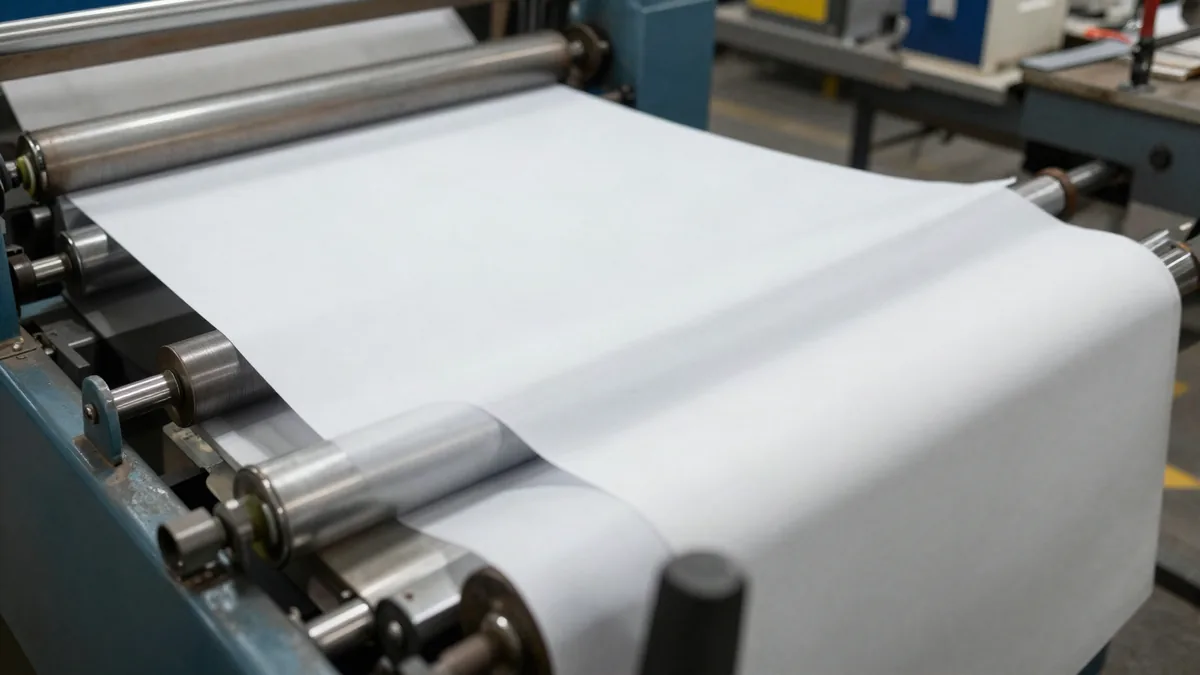
Flatwork -- sheets, tablecloths, napkins -- typically runs through a flatwork ironer that dries and presses in one pass, producing the crisp finish expected in hospitality settings. Terry and shaped garments go through tumble dryers instead, since ironing a towel or a folded garment adds no value. Finishing speed and quality vary more between plants than almost any other stage in the process, which is why the crispness of a delivered sheet is often the fastest visible signal of overall plant quality.
Quality inspection, reject rates and rewash
Finished items pass an inspection step -- visual checks for staining, tears and residual soil -- before packing. Items failing inspection get rewashed rather than shipped, and a plant's reject rate is a real quality signal worth asking about directly, since a provider that skips inspection under route pressure is the one whose stained sheets show up at your front desk. A plant confident in its own quality control will usually give a straight answer to a direct question about its reject and rewash rate.
Packing and route delivery
Clean textiles are counted, packed into carts or bags by account, and loaded back onto the route truck for delivery on the next scheduled stop. Accurate counting here is what protects both sides from billing disputes later -- a receiving signature against a counted delivery is the paper trail that resolves a "you shorted us" argument two months into a contract. It is a small procedural habit that costs almost nothing to enforce and saves real money the first time a dispute actually happens.
Who buys commercial laundry services
Hotels and resorts, restaurants and food service operators, hospitals and clinics, gyms, salons and spas, and industrial and automotive shops make up the large majority of demand, each with a different mix of flatwork, terry, uniforms and specialty items. Property managers, franchise operators and multi-site facility teams buy at a portfolio level, consolidating what would otherwise be dozens of separate site-level contracts into one negotiated agreement. Anywhere textiles get soiled daily as a byproduct of doing business is a plausible buyer, which is why the provider landscape spans from hyper-local independents to national conglomerates, and why the right provider for a single restaurant looks nothing like the right provider for a hospital system.
How the industry is structured in the US
The US market runs on a mix of a handful of large national groups, several hundred regional independents each covering one metro area or state, healthcare-dedicated laundries and co-operatives, and a long tail of smaller wash-and-fold plants selling spare B2B capacity. Trade bodies including TRSA set voluntary certification standards that a meaningful share of the industry adopts, particularly for healthcare and food-service work, though certification is not a legal requirement to operate. Consolidation has been steady for decades, but route-density economics keep regional operators viable even against much larger national competitors, since a truck already running a tight loop through a metro area beats a national's longer haul on cost every time.
What to look for when you are new to buying it
Start with what a commercial laundry service company actually looks like before requesting quotes, since the type of company you approach shapes every term that follows. Then get a handle on what commercial laundry actually costs so you can tell a genuinely competitive bid from one that is merely underpriced on the headline rate and padded elsewhere. New buyers lose the most ground by signing on rate alone before understanding contract term, minimums and what a plant will and will not process -- read the fine print before the first invoice, not after it. The commercial laundry terms glossary is worth bookmarking before your first contract review, since a surprising amount of the fine print is written in industry shorthand that is never actually defined on the page it appears on.
Frequently asked questions
What is a commercial laundry service?
A commercial laundry service is a business that collects, washes, finishes and returns textiles for other businesses at industrial scale — hotel bed linen, restaurant napery, healthcare gowns, gym towels, shop rags and uniforms. It is a recurring route service, not a one-off drop-off.
How is commercial laundry different from a laundromat?
A laundromat rents machine time to individuals. A commercial laundry runs its own plant, processes hundreds of pounds per load on tunnel washers, collects and delivers on a fixed route, and bills a business on a contract by weight, by piece or by employee.
How does commercial laundry work end to end?
Soiled textiles are collected on a route day, sorted by classification, washed in a validated formula, dried or ironed, inspected for stains and damage, counted, packed and returned on the next route day. Most contracts run on a two-to-five day cycle with a par stock buffer at your site.
Is commercial laundry the same as dry cleaning?
No. Commercial laundry is water-based washing at scale. Dry cleaning uses solvent and is used for garments that cannot be wet-washed. Some plants offer both, but they are separate processes with separate costs.
What size business needs a commercial laundry service?
In practice, anywhere from roughly 200 pounds a week upward. Below that, most providers' minimum weekly charges make the effective cost per pound uneconomic and an on-premise machine or a wash-and-fold arrangement is usually cheaper.