Commercial Laundry Service Companies in the United States
"Commercial laundry service companies" is a broad label. It covers a national uniform and linen conglomerate running two hundred routes a day and a twelve-person wash-and-fold plant that just started taking business accounts. Searching for one turns up all of them, undifferentiated, and the differences between them matter more than any single review score. Route density decides which days a truck can reach your dock. Contract length decides how long you are locked into a rate that looked good in year one. Plant certification decides whether the operation meets the standard your industry actually requires. None of that shows up in a star rating, which is why a shortlist built on rating alone tends to fail on operational fit six months in. This page sorts the field into the four types of company that answer to "commercial laundry," lays out what actually separates one bid from another, and gives a method for narrowing a search to three real candidates instead of a scroll of phone calls. Treat the four categories and the shortlist method below as the fast path through that noise.
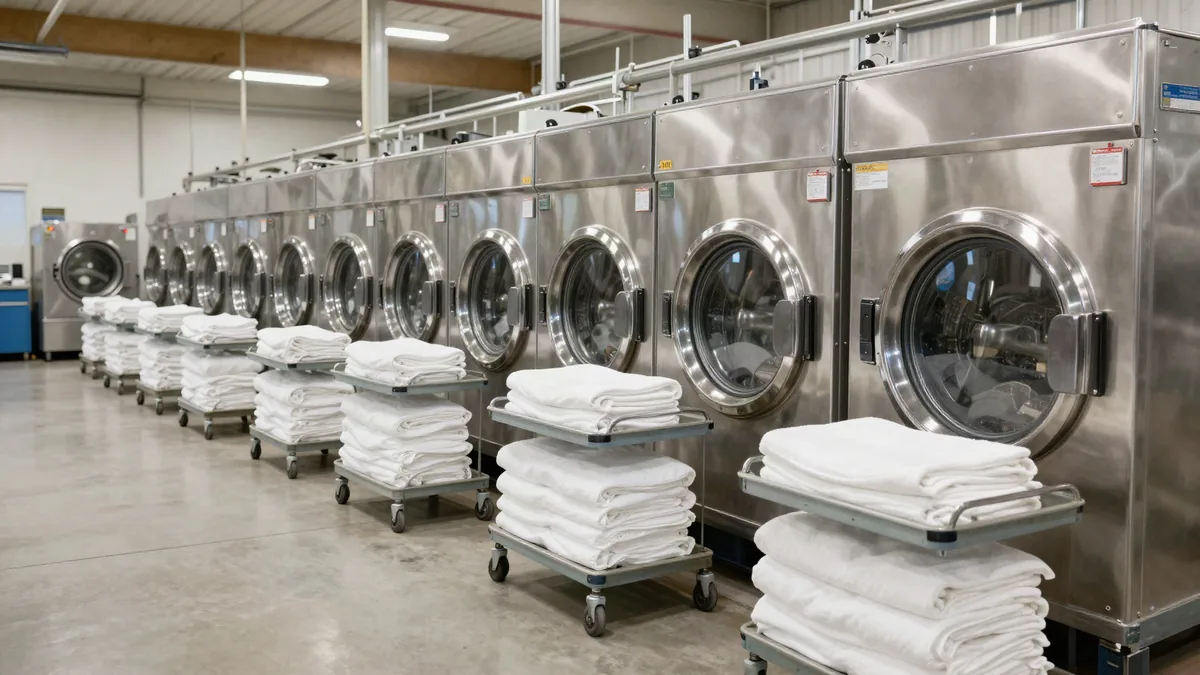
The four kinds of company that call themselves a commercial laundry
Before comparing rates, work out which type of company is actually behind a given quote. The differences below decide route flexibility, contract structure, and what happens if your volume changes mid-year -- details that rarely surface until page three of a proposal, well after the sales call has set your expectations. Two providers quoting an identical per-pound rate can turn out to be very different partners once you know which of the four they actually are.
National uniform and linen rental groups
The largest operators run regional plants networked under one brand, serving thousands of accounts across multiple states. Scale buys them purchasing power on linen stock and machinery, and a back office built for multi-site billing -- useful if you are standardizing service across ten locations in six states. What it costs you is route flexibility: a single account rarely moves a national's route schedule, and contract terms are standardized rather than negotiated line by line. If the incumbent national's renewal terms are the reason you are shopping in the first place, nine Cintas alternatives worth putting in your next bid is a useful starting list. Multi-site procurement teams often value that consistency enough to accept the reduced flexibility in exchange for standardized reporting across every location.
Regional independent linen companies
Independents typically run one to three plants and cover a metro area or a handful of adjacent states. They can move a route day, adjust a par level, or negotiate a shorter term because the owner is often the person who approves the exception. The trade-off is coverage: an independent that serves your headquarters may have no route within a hundred miles of a satellite location. The national versus regional trade-offs are worth reading in full before you assume bigger is automatically safer or smaller is automatically more responsive -- the honest answer depends on how spread out your sites are. Ask directly how many plants a regional independent runs and where, since single-plant coverage across a wide area raises real backup-capacity risk.
Healthcare-only laundries and co-operatives
A subset of independents and hospital-owned co-operatives process nothing but healthcare textiles -- surgical linen, isolation gowns, patient apparel -- under HLAC accreditation or a validated barrier-wash process. Hospitals and surgical centers should treat that specialization as close to mandatory rather than a nice-to-have; a general hospitality laundry running healthcare loads through the same equipment as hotel sheets is a real infection-control question, not a formality. Ask directly whether healthcare volume runs on dedicated machines with a dedicated wash formula, and get the answer in writing. That distinction is not cosmetic -- cross-contamination between healthcare and general textiles is exactly the kind of risk an accreditation audit exists to catch before it becomes an outbreak investigation.
Wash-and-fold plants selling B2B capacity
Plants built for high-volume consumer wash-and-fold have started selling spare capacity to small business accounts -- gyms, salons, short-term rental turnover -- usually priced per pound with no long-term contract. It is the easiest entry point for a business too small to interest a rental company's minimum, but the service is generally wash-only: no stock rotation, no par level held on your behalf, and no rental linen supplied. You are sending your own goods through their machines and getting the same goods back, which is a different relationship than a linen contract even when the invoice looks similar. It works well as a bridge while a smaller operation is too small for a rental minimum, less well as a long-term arrangement once volume justifies a full contract.
What actually differs between them
Company type sets the general shape of the relationship; these four variables decide whether a specific bid actually works for your site. Compare them line by line across every quote you collect -- a lower headline rate paired with a worse answer on any of the four usually costs more within a year, not less. None of the four is visible on a rate sheet, which is exactly why they belong on your question list before the number does.
Route density and why it decides your delivery days
A provider's route density in your zip code -- how many other accounts it already services nearby -- sets the delivery days it can offer you, not the other way around. A route already running through your area three days a week can plausibly add a fourth stop; one running through once a week cannot compress to daily service no matter what a sales rep offers verbally in the meeting to win the account. Ask how many other stops sit on your proposed route before you ask about price -- it tells you more about what is actually deliverable. The honest version of that answer often differs from what gets promised verbally before a contract is signed.
Contract length, auto-renewal and exit terms
Linen and uniform rental agreements commonly run three to five years with an automatic renewal clause that re-locks the term unless you cancel inside a narrow window, often sixty to ninety days before expiration. Wash-only and per-pound arrangements are more often month-to-month. Read the renewal and termination-for-cause clauses before you read the rate table; the rate is renegotiable at renewal, but a clause that auto-locks you for another five years is not something a friendly account rep can undo after the fact. Some contracts also escalate the rate automatically at each renewal by a fixed percentage; find that clause and calculate what it does to your cost by year five, not just year one.
Plant certification: TRSA Hygienically Clean and HLAC
TRSA's Hygienically Clean certifications (Healthcare, Food Service, Hospitality) and HLAC accreditation both audit wash formulas, water temperature and handling procedures against a validated standard, renewed periodically rather than granted once and forgotten. Certification is close to a requirement for healthcare and food-service textiles, and a meaningful but non-exclusive signal everywhere else -- plenty of solid regional operators run clean plants without paying for the audit that would prove it on paper. Ask to see the certificate directly rather than taking a website badge at face value, and check the renewal date -- an expired certification still displayed online is a real warning sign about how the operation is run more broadly.
Minimum weekly charges and route minimums
Nearly every rental contract carries a minimum weekly charge, a floor on the invoice regardless of actual volume sent that week. A small account routed at close to that floor pays an effective per-pound rate well above the quoted headline number. Ask for the minimum in writing and run your expected weekly volume against it before comparing rates across bids -- it is the single most common reason a "cheap" quote turns out to be the expensive one once the invoices start arriving. Some providers will negotiate the minimum down for a longer contract term, which can be a reasonable trade for a small account that expects to grow.
How to build a shortlist of three
Collect one quote from a national group, one from a regional independent, and one from a specialist in your industry where one operates in your area. Fewer than three gives you no price anchor to negotiate against; more than three rarely changes the outcome and adds weeks to a decision that should take two. Send every candidate the identical volume and item list so the numbers are actually comparable, and ask each for a sample invoice rather than a rate sheet alone -- the invoice is where minimums and surcharges actually show up, not the pitch deck. Score the three on delivery days offered, contract term, and certification before you look at the headline rate; the cheapest bid on paper is frequently the most expensive one to actually operate against once the exceptions start piling up. For a longer walkthrough, see the 12-point vetting checklist.
What a commercial laundry cleaning service will and will not take
Most plants accept standard textiles without hesitation: bed and bath linen, table linen and napery, chef coats and aprons, bar mops, shop towels and standard uniforms. Fewer will run flame-resistant garments, items with heavy grease or solvent contamination, anything carrying a sharps risk, or specialty fabrics like down comforters and leather. Some categories are excluded for equipment reasons -- a tunnel washer is not built to run a single down comforter -- and others for liability, particularly flame-resistant and bio-contaminated items, which require a dedicated process and often a dedicated vendor entirely separate from your general contract. Confirm exclusions in writing before you assume a broad "we handle everything" answer on a sales call actually covers your specific inventory once it is tested against the plant's real capability. When in doubt, send your actual inventory list and ask for a yes or no against each line rather than a general assurance.
Where to find companies serving your area
Route coverage is local even when the company is national, so the useful question is which providers actually run a truck through your zip code, not which company has the best-known name. Two state directories cover this in depth: commercial laundry companies in Texas and commercial laundry companies in California both break coverage down by metro area and route type. If you would rather search by proximity than by state, commercial laundry service near you is the faster way in. Whichever you use, verify route days and minimums directly with the provider -- a directory listing describes a coverage area, not that specific week's schedule, and the two are not always the same thing once a route fills up. None of the three replaces a direct phone call confirming that specific week's route capacity before you commit inventory to a new provider.
Frequently asked questions
What is the difference between a commercial laundry and a linen rental company?
A commercial laundry washes textiles you already own and returns them to you. A linen rental company owns the textiles, launders them and rotates clean stock in on a route, billing per piece or per week. Many companies do both; ask which model a quote is based on before you compare prices.
How many commercial laundry companies should I get quotes from?
Three is the practical number — one national group, one regional independent and one specialist in your industry. Fewer than three gives you no price anchor; more than three rarely changes the outcome and slows the decision by weeks.
Are national commercial laundry companies cheaper than regional ones?
Not usually on unit price. Nationals win on multi-site consolidation and back-office simplicity; regionals typically win on route flexibility, shorter contracts and lower minimum weekly charges. The gap shows up in the fine print, not the headline rate.
What certification should a commercial laundry company hold?
For healthcare textiles, look for HLAC accreditation or TRSA Hygienically Clean Healthcare. For food service, TRSA Hygienically Clean Food Service. For general hospitality and industrial work, certification is common but not universal and its absence is not automatically disqualifying.