What a Commercial Laundry Service Costs in 2026
Commercial laundry service prices are quoted three different ways -- per pound, per piece, per employee -- and rarely quoted in a form that makes one provider's number directly comparable to another's. The headline rate is also, reliably, not the number that shows up on the invoice: minimum weekly charges, fuel and environmental surcharges, loss and replacement charges, and garment prep fees sit outside it and can add a meaningful percentage to the real cost of the contract. This page sets out the three pricing models, the 2026 US price bands by industry, everything that typically sits outside the headline rate, and a method for normalizing three different quotes onto one comparable number before you sign anything. Read it before you request a single quote, and the number a sales rep quotes verbally will stop sounding like the whole answer. Every figure below reflects US market data as of 2026 and should be re-checked against a current quote before you rely on it for a budget line, since fuel costs and route economics both shift year to year.
The three ways commercial laundry is priced
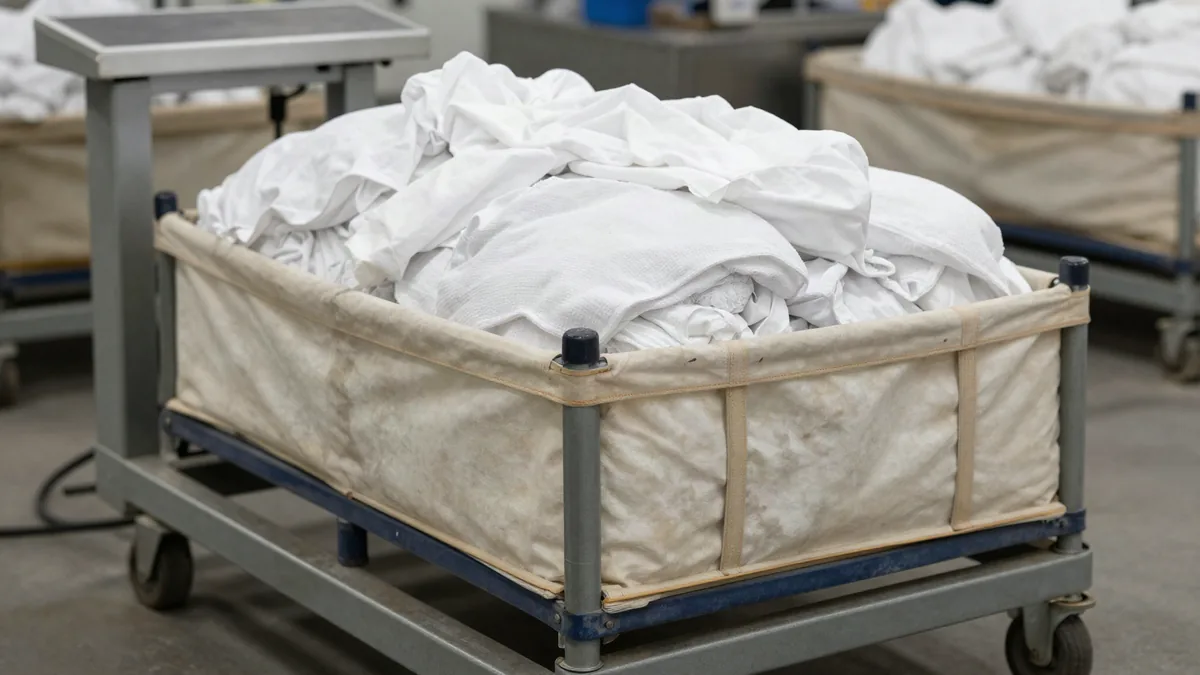
Nearly every commercial laundry contract in the US prices on one of three bases, and which one a provider defaults to usually reflects what kind of textile mix they are set up to process most efficiently, not a deliberate attempt to obscure the real cost. Knowing which basis applies to a given quote is the first step toward comparing it honestly against a competitor quoted on a different basis entirely. For a fuller walkthrough of how each model actually behaves in practice, see per pound, per piece or per employee.
Per pound
Per-pound pricing weighs soiled textiles on collection and bills against that weight, making it the standard model for high-volume flatwork -- sheets, towels, table linen -- where item-by-item counting adds cost without adding accuracy. It rewards heavy, uniform, low-handling loads and penalizes light, bulky, high-handling items, since those cost the same to process but weigh very little. Providers running mostly hospitality flatwork accounts tend to default to this model because it matches the shape of their typical customer's volume, and negotiating a per-piece alternative against their preference is usually an uphill conversation.
Per piece
Per-piece pricing bills a set rate for each garment or item type -- a chef coat, a folded tablecloth, a uniform shirt -- regardless of weight. It suits items that need individual finishing, hanging, or folding rather than bulk processing, and it makes cost forecasting simpler when item counts are predictable but weight varies a lot between wash cycles. The trade-off is that a per-piece rate card can run to dozens of line items once a contract covers a full uniform program, which makes it harder to eyeball a bid at a glance than a single per-pound number.
Per employee, per week
Uniform rental programs commonly bill a flat rate per employee per week, covering a set number of garments in rotation regardless of exact wash volume. It simplifies budgeting for HR and operations teams managing headcount that changes over time, at the cost of paying the same rate in a slow week as a busy one. Seasonal businesses with large headcount swings should ask specifically how the rate adjusts when staff numbers drop, since some contracts hold the per-employee minimum fixed regardless of actual headcount that week.
Typical 2026 US price bands by industry
Most US commercial laundry contracts land between roughly $0.85 and $1.75 per pound in 2026. Where a given industry sits inside that band, or outside it, comes down to soil level, handling complexity and regulatory requirements -- not geography, which moves the number far less than buyers expect. The bands below describe where an industry's typical mix tends to land relative to that anchor, not a fixed price list; your own specific item mix and volume still move the final number inside or even outside the range.
Hotels and resorts
Hospitality flatwork -- sheets, pillowcases, bath towels -- is heavy, uniform and low-handling, which places most hotel and resort contracts in the middle to lower half of the per-pound band. High thread-count linen and specialty items like duvet covers push individual line items toward the upper half, but the bulk of the volume is the cheapest category to process in the whole industry mix. Resorts running heavy pool and spa towel volume alongside room linen tend to sit slightly higher in the band than a limited-service hotel with room linen alone, simply because towel turnover per guest-night runs higher.
Restaurants and food service
Napery and aprons carry heavier, harder-to-remove soil -- grease, sauce, wine -- than hospitality flatwork, which typically pushes food-service contracts toward the middle of the band or above it. Chef coats and other per-piece items often get priced separately from bulk napkins and tablecloths, so a food-service quote is rarely a single blended rate the way a hotel's often is. Fine-dining operations running white linen tablecloths in volume typically sit toward the upper half of the band, since visible staining tolerance is lower and rewash rates run higher than at a casual concept.
Healthcare and clinics
Healthcare textiles sit at or above the top of the band, driven by validated wash formulas, higher wash temperatures, barrier-processing requirements and the certification overhead -- HLAC or TRSA Hygienically Clean Healthcare -- that a credible provider carries. The premium reflects real compliance cost, not just positioning, and a bid priced well below the band for genuine healthcare volume is worth questioning rather than celebrating, since it usually means a compliance corner is being cut somewhere in the process that will not show up until an audit.
Gyms, salons and spas
Towel-heavy, low-complexity loads with light, consistent soil put gyms, salons and spas near the lower half of the band, similar in profile to hotel flatwork. Volume tends to be smaller than hospitality accounts, though, which means minimum weekly charges bind more often here than the per-pound rate itself does -- a small studio's effective rate is frequently set by the floor, not the quoted per-pound number, regardless of how competitive that number looks on the rate sheet.
Industrial and automotive
Shop towels, coveralls and other heavily-soiled industrial textiles -- oil, grease, solvent residue -- require more aggressive wash chemistry and more frequent equipment maintenance on the provider's side, which places this category at or above the top of the band. Some heavily-contaminated items also carry a hazardous-material handling surcharge layered on top of the base per-pound rate, and shops running solvent-heavy operations should confirm upfront whether their volume even falls within a given plant's accepted contamination threshold before requesting a rate at all.
What is not in the headline rate
The quoted per-pound, per-piece or per-employee rate is a starting point, not the invoice. Four categories of charge sit outside it on nearly every contract, and asking about all four before signing is the single highest-value question a buyer can ask -- more valuable, in practice, than negotiating the headline rate down another few cents.
Minimum weekly charge and route minimums
A floor on the weekly invoice regardless of how little volume you send, justified by the fixed cost of stopping a truck at your door whether it is full or nearly empty. If your expected volume sits close to the minimum, your effective per-pound rate runs far above the quoted one, and the gap only shows up once real invoices start arriving. The mechanics of how minimums get set and negotiated are covered in full in minimum weekly charges and route minimums.
Fuel, energy and environmental surcharges
Variable line items tied to fuel costs, utility rates or a provider's stated sustainability compliance costs, typically expressed as a percentage of the base invoice rather than a flat fee. They fluctuate with market conditions outside either party's control and are worth asking about as a percentage range up front, not just a line-item name on a sample invoice, since a surcharge quoted as "up to 8 percent" behaves very differently on your budget than one that has held steady near 3 percent for two years running.
Loss and replacement charges
Items that do not come back -- lost, damaged beyond repair, or worn past the point of rag-out -- get billed to the customer at a replacement rate set in the contract, on rental agreements where the provider owns the stock. This is one of the most common sources of invoice disputes precisely because the replacement rate is rarely reviewed carefully at signing, and it is frequently set closer to full-retail replacement cost than to the item's actual depreciated value at the point it goes missing.
Garment prep, emblems and sizing fees
Uniform programs commonly add one-time or per-item charges for embroidered names, company emblems, initial sizing and garment prep before an item enters rotation. These are usually modest individually but add up meaningfully at onboarding for a larger headcount, and they rarely appear on the headline rate sheet a sales rep leads with. Ask for the full onboarding fee schedule in writing before you sign, especially if you are outfitting more than a handful of employees at once.
How to normalise three quotes onto one number
Take a real week of your own volume -- actual pounds, actual piece counts, actual headcount -- and price it against each quote's full rate card, not just the headline number. Add the minimum weekly charge if your volume falls under it, add the stated surcharge percentage, and add a reasonable estimate for loss and replacement based on the contract's stated rate. What comes out the other end is an effective weekly cost per provider that is genuinely comparable, which the three headline rates on their own almost never are once every hidden line item is accounted for honestly. Build this as a simple spreadsheet rather than doing it in your head during a sales call -- the whole point is to catch the number that a fast verbal comparison would miss.
When per-pound beats per-piece, with worked numbers
Consider 300 pounds of hotel flatwork a week priced at $1.10 per pound: $330. Priced per piece instead, at roughly 40 pieces per 25 pounds and $0.35 per piece, the same load runs closer to $420 -- per-pound wins because the load is heavy, uniform and needs no individual finishing. Now consider 40 chef coats a week: per piece at $2.25 each runs $90, while the same coats priced per pound at a light 40-pound total and $1.10 per pound runs only $44 on paper but does not reflect the individual finishing labor the coats actually require, which is why plants rarely offer per-pound pricing on that category at all. Price your own actual weekly mix both ways before assuming either model is cheaper by default -- the crossover point depends entirely on how heavy and how uniform your specific item mix actually is, and it moves every time that mix shifts.
Getting a quote that is actually comparable
Ask every candidate for a sample invoice, not just a rate sheet -- rate sheets show the headline number, invoices show the minimum, the surcharges and the fee structure together. Request pricing in writing against the same stated volume and item list for every bidder, and ask directly what the contract term and renewal clause are before you negotiate rate, since commercial laundry contracts commonly lock in more than the rate does. For a deeper breakdown of the fee categories that catch buyers most often, see uniform rental hidden fees and fuel, environmental and energy surcharges. For a wider look at what businesses across every industry actually pay once every line item is included, commercial laundry service cost: what US businesses actually pay pulls the full picture together in one place.
Frequently asked questions
How much does commercial laundry cost per pound?
Most US commercial laundry contracts land between roughly $0.85 and $1.75 per pound in 2026, with healthcare and specialist work above that band and high-volume flatwork below it. Route density, volume and contract length move the number more than geography does.
Why is my commercial laundry bill higher than the rate I was quoted?
Almost always because of items outside the unit rate: the minimum weekly charge, fuel and environmental surcharges, loss and replacement charges for missing items, and garment prep fees. Ask for a sample invoice, not just a rate sheet, before you sign.
What is a minimum weekly charge?
A floor on your weekly invoice regardless of how little you send. It exists because the cost of stopping a truck at your door is fixed. If your volume is close to the minimum, you are paying an effective per-pound rate far above the quoted one.
Is per-piece or per-pound pricing better?
Per-pound favours heavy, uniform, low-handling items such as hotel flatwork. Per-piece favours light items that need individual finishing, such as chef coats and tablecloths. Price the same week's actual volume both ways before choosing.
How long is a typical commercial laundry contract?
Thirty-six to sixty months is standard for uniform and linen rental, often with automatic renewal. Wash-only and per-pound arrangements are frequently month-to-month. The renewal clause matters more than the term length.