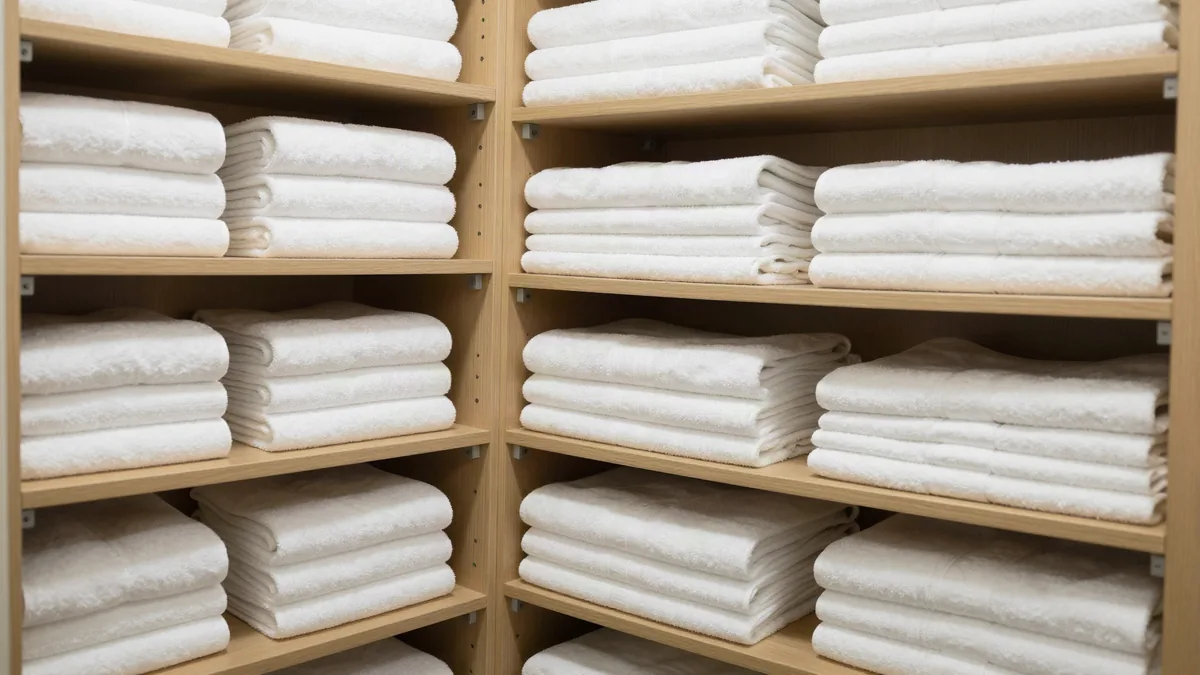
Senior Living and Nursing Home Linen: Resident Personals and Loss Control
Bottom line: Separate resident personals from facility linen at the source, tag them with permanent IDs, count every piece on pickup and delivery, and pay a premium for a service that assumes the loss risk.
I've been in this business for 20 years, and I've seen more lost cardigans than lost sheets. The mistake I watch facilities make is treating personals like bulk linen. They get tossed into the same cart, sorted by nobody, and then the nursing home linen service gets blamed when something disappears. Last month I audited a 120-bed facility that claimed a 2% loss rate on resident clothing. I found 14 items in one laundry load that had no ID tag and no way to get back to the resident. That's not a laundry problem, that's a system problem. You need a separate stream from the moment the clothes come off the resident. Healthcare Linen Service
Last Tuesday I stood in a nursing home laundry room holding a pair of slippers with 'Evelyn' written in marker on the sole. They'd been through a 135-degree wash and came out looking like they'd survived a car wreck. The family wanted them replaced. The facility wanted to blame us. The truth is, nobody really knew how they got in with the bath towels, and nobody could prove who lost them.
That's resident personals in a nursing home linen service. It's not just sheets and gowns. It's Mrs. Kowalski's cardigan and Mr. Reyes's flannel pajamas. These are the clothes people live in, and losing them isn't a small thing. It's a matter of trust, dignity, and money.
Loss control is the whole ballgame. If you can't keep track of a resident's own clothes, you've failed at the most human part of this job.
Resident Personals Are Not Scrubs
Hospital linens are standardized, high-volume, durable. Sheets and towels can take a beating. Resident personals are the opposite: cotton, wool, delicate, full of buttons and zippers. You can't run them through the same tunnel washer and expect them to survive. A good service sorts them out, uses a different wash formula with a neutral pH, and maybe even a lower temperature, say 140 degrees instead of 160. And that's fine for hygiene — the chemistry does the work, the heat doesn't have to.
But the real issue isn't chemical damage. It's loss. When you're processing 1,200 pounds of linen a day, a single t-shirt with a handwritten name on a tag is a needle in a haystack. Without a system, it's gone. And the system has to start at the bedside.
That's why I push every facility I work with to have a clear identification protocol. Iron-on labels, laundry pens, or RFID tags. If the item can't be marked, don't send it to the plant. Call it a rule of thumb: if it's not marked, it's in danger.
The Real Cost of a Missing Sock
The direct cost of a lost item is easy to calculate. A pair of sweatpants costs maybe $8 to replace. A resident's own wool sweater? $60 or more. And then there's the labor: the time spent searching, the phone call to the family, the goodwill burned. I've seen a facility lose a $200 quilt and then spend $400 of staff time trying to find it.
In my experience, you'll lose somewhere between 2% and 5% of all resident personal items every month if you don't have a solid process. That might not sound like much, but in a 120-bed facility, that's a few hundred dollars a month and a lot of bad feelings. Give or take. The fix isn't more tracking, necessarily. It's accountability. Who's responsible for moving the item from the resident's room to the laundry bag? Who checks the bag at the door? Who returns the clean items?
A good nursing home linen service will have this built into their workflow. They'll use color-coded bags for personals, separate carts, and a check-in sheet at the plant. If they don't, you're going to be chasing missing socks forever.
How a Good Service Actually Handles Personals
Here's what it looks like when a plant gets it right. The cart has a designated bin for personals, lined with a red or blue bag. The laundry worker at the facility scans a barcode on the bag, so the contents are attributed to a specific resident. At the plant, the bag is opened, and each item is checked against a list. Some plants photograph the items on a table, but that's the old school. The new school uses RFID chips sewn into the hem.
Then the wash cycle. For personals, the wash engineer uses a shorter cycle, milder chemicals, and a cooler temperature. The items go into mesh bags to keep them from tangling. After drying, they're folded and returned to the resident's room, not to a central pickup area. That last step is crucial. If the items go to a common area, they'll get mixed up again.
This level of handling costs more. Expect to pay a premium per piece — call it 20 to 30 percent more than standard linen. Or look for a per-resident price that bundles it in. But don't be surprised when a service that promises to do this for the same rate as bulk linen cuts corners. You get what you pay for.
Pricing and Contracts That Don't Burn You
Linen pricing is a game of three models: per pound, per piece, and per resident. Per pound is the most common, but it's the worst for resident personals. It encourages the service to keep items wet and heavy, and it pays them the same for a towel as for a sweater. Per piece is better — you know what you're paying for each item, and the service has to account for each piece to get paid. Per resident is simplest: a flat monthly fee based on the average census. That works well for a facility that has steady occupancy.
Here's the thing I always tell people: read the contract for what happens when items are lost. Some contracts shift the liability to you — you buy the replacement, or you pay a "lost item" fee. Others include a certain amount of loss in the price. Make sure you know which one you're signing. And if the contract has a clause that calculates monthly overages based on "excess usage," that's a red flag. In a hospital, everything is excess usage.
For uniforms, a similar logic applies. If you're renting scrubs or uniforms for staff, you'll typically pay $4 to $15 per employee per week, depending on the number of pieces and the schedule. That's a well-established range, but it doesn't translate to linens. So when a sales rep quotes you a price, ask them which model they're using. If they can't tell you, walk away.

Certifications and Standards You Should Demand
I don't care if the plant has the shiniest trucks on the road. I ask three questions. Are you TRSA Hygienically Clean certified? Do you have HLAC accreditation? And can you show me your OSHA 1910.1030 exposure control plan? These aren't buzzwords. TRSA's Hygienically Clean program is a third-party certification that verifies the plant follows best practices for hygiene and process. HLAC, the Healthcare Laundry Accreditation Council, goes further with inspections and scoring. If a plant is accredited, they're serious.
But even with certifications, you have to be honest about what they do and don't prove. They verify process, not clinical outcomes. A certified plant won't necessarily reduce a facility's infection rate — that's a clinical claim no one can make from a laundry audit. What they will do is ensure every load is processed at the right temperature, with the right chemistry, and the right handling. That's the standard you're paying for.
And if you ever deal with flame-resistant garments — think FR pajamas for a resident who smokes, or FR uniforms for your maintenance crew — don't let anyone tell you home washing preserves their protection. It doesn't. Industrial laundering in a certified plant is the only way to maintain the FR properties under NFPA 2112 and NFPA 70E. So either budget for a proper service or don't buy FR garments. There's no middle ground.
Resident Personals Handling Options Compared
| Approach | Cost per pound | Loss responsibility | ID tagging method | Contract terms |
|---|---|---|---|---|
| Bundled with nursing home linen service | $0.60 - $0.80 | Service covers up to 2% monthly loss; facility pays for extra | Permanent woven tags or QR codes required | Monthly minimum, usually 500 lbs |
| Separate specialty personals service | $0.85 - $1.10 | Service replaces lost items within 48 hours | Service provides and applies labels | No minimum, per-batch pricing |
| In-house personals processing | $1.00 - $1.25 | Facility assumes all loss | Staff use fabric markers or iron-on labels | Not applicable, internal labor and supplies |
Frequently Asked Questions
How does nursing home linen service pricing work?
You'll see three common models: per pound, per piece, or per resident. Per pound is common for bulk linens but is a bad fit for resident personals because it doesn't account for the extra handling. Per piece works well because you're charged only for what's processed. Per resident is a flat fee based on the number of residents, which is predictable if your occupancy is stable. Always ask which model the quote is based on.
What can we do to reduce loss of resident clothing?
Mark every item with a permanent laundry label or use RFID tags. Categorize personals separately from bulk linen at the source. Use color-coded bags and a check-in sheet. Train staff to never place personal items in the regular soiled-linen bin. And make sure your contract with the service includes a lost-and-found procedure with a clear timeline.
Is it better to wash resident personals on-site or with a nursing home linen service?
On-site washing gives you control, but it costs you labor, chemicals, water, and maintenance. It also risks damaging items if your staff isn't trained for delicate loads. A professional service can do it for a comparable cost per piece, with better sorting and tracking. Depends on your plant and your staff. If you have a small facility and a good washer, doing it on-site can be fine; for anything over 60 beds, I'd consider a service.
What certifications should a nursing home linen service hold?
Look for TRSA Hygienically Clean, which verifies hygiene and processing standards, and HLAC accreditation, which is a deeper inspection of the entire operation. For OSHA compliance, a service must have a bloodborne pathogen control plan per 1910.1030, but that's a regulatory requirement, not a certification. If the service handles flame-resistant garments, they should be able to reference NFPA 2112 standards for industrial laundering.