Flu and RSV Season: Scaling Healthcare Linen When Census Spikes
Bottom line: Negotiate a surge clause with your linen service now: 20% buffer stock, next-day delivery triggers, and overtime authorization.
I've seen census jump 25% overnight and the linen room look like a war zone. The mistake is thinking your normal par level will flex. It won't. We keep a 20% surge buffer on consignment at three hospitals now, and it still wasn't enough when RSV hit early. What saved us was a pre-agreed trigger: any night that admin projects a 10% census increase, we automatically get a next-day priority delivery, double order, and an extra driver on call. That's the difference between a bad day and a disaster. Our hospital clients who have this in writing before flu season don't call me at 6 a.m. with pictures of empty shelves. The others do. Healthcare Linen Service
The first Wednesday of flu season last year, my phone buzzed at 6:14 a.m. The linen supervisor at our largest hospital had sent a picture: the clean shelf empty, the soiled cart piled to the ceiling. Census had jumped 18 percent overnight, and the ED was holding 14 patients.
That's what a spike feels like. It's not the flu itself that busts you; it's the sudden acceleration. You don't get a week of warning. You get a week of laundry piling up and a crew that can't fold fast enough. This year, I'm doing it differently.
The math of a spike
Let's crunch the numbers. A normal medical/surgical bed uses about 20 pounds of linen a day, give or take. With 400 beds, that's 8,000 pounds clean. If the census goes up 20 percent, you need 9,600 pounds. But your washer and dryer capacities don't grow. A Milnor 480 pound washer runs about 45 minutes a load. That's 640 pounds an hour, call it 600 for downtime. You're behind before lunch.
We run par levels on the shelves. Our target is 2.5 full turns per day across all four hospitals. When census spikes, that turns into 1.5. The ER alone burns through isolation gowns like paper—and that's not a metaphor. We've seen a single flu week eat three weeks of surgical mask inventory, but that's a different supply chain. For linen, the challenge is sheer volume and turn time.
Surge inventory and vendor partners
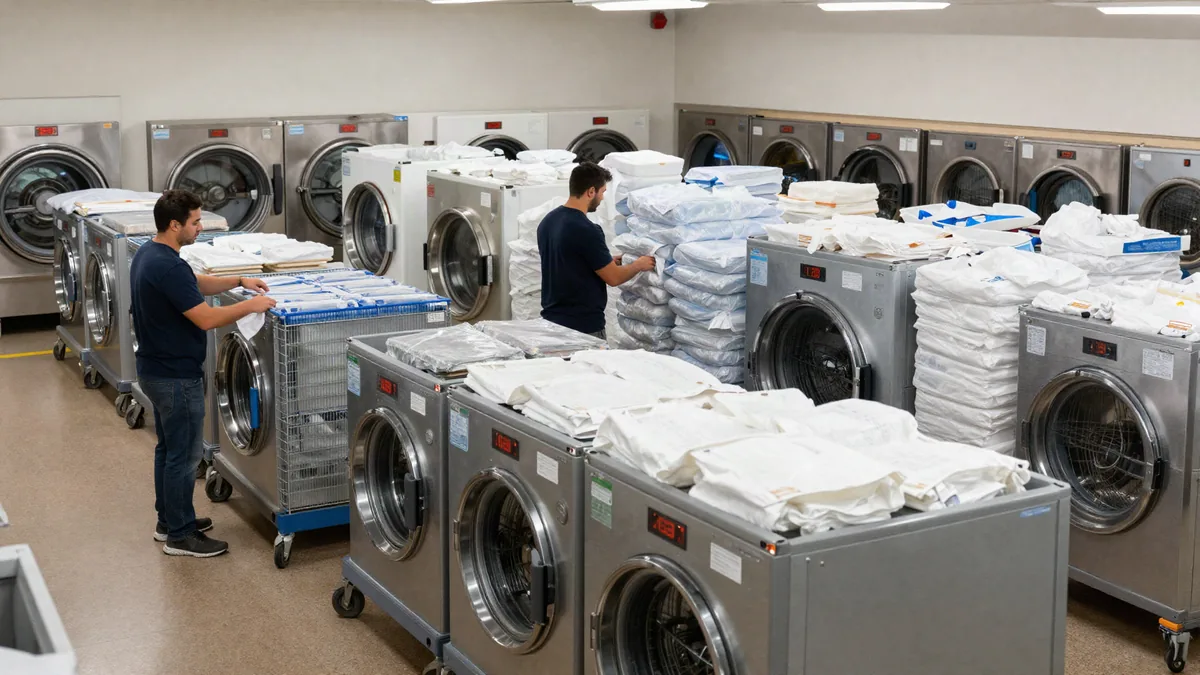
We keep a trailer of clean linen parked behind the distribution center. It's not a mystery: we rent those from Cintas, and they know the hospital calendar. In October, I call our rep and ask for an extra 20 percent on our standing order of patient gowns and draw sheets. It's a contract conversation, not a charity. We pay per pound for processing, and we pay a storage fee for the trailer. It depends on the plant, but for us it's cheaper than running out.
We also lean on our local cooperative. We're part of a group purchasing organization, so we can buy from Medline at scale. But the trick is having the space to store it. A hospital basement isn't a warehouse. We put the surplus in a second trailer and run a shuttle twice a day. That's a logistics fix, not a hero move.

Workhorse linen and what we boost
It's not just any linen. A flu season spike is a pediatric and med-surg event. We stock more of the 60-inch draw sheets, the standard patient gowns, and the thermal blankets. We order maybe 30 percent more blankets from Southern Textile in September. They're cheap, but they're the first thing a nurse pulls when a patient's temp is 102.
And here's where a materials manager would digress: the OR doesn't stop. Surgical linen is a separate loop, with its own counts and its own hygiene requirements. We can't borrow from those par levels. Their absorbent towels, wrappers, and gowns get processed in a separate batch that uses different wash formulas to meet TRSA Hygienically Clean standards. So the flu season planning has to respect that boundary. Same plant, different wash room.

Compliance and process under pressure
When the chutes get hot, your process is what saves you. Every soiled item goes into the wash with the same protocol: an Ecolab detergent system, proper temperatures, and verified wash conditions. We audit each load on a dial thermometer, and we send monthly swabs to an independent lab that checks for biological cleanliness. That's what TRSA Hygienically Clean certification requires. We also train staff on OSHA 1910.1030 – the bloodborne pathogen standard – because you never know what's on a soiled sheet.
The temptation is to speed up, fast cycle, cooler water, less chemical. Don't. A hospital isn't a hotel. You can't cut corners on hygiene and call it a day. The whole system – our HAIs, our patient satisfaction scores, our Joint Commission surveys – depends on us being boring and consistent. And that's exactly what I tell my team: be boring. Follow the checklist. The certification is just paperwork; the habit is real.
Comparing Surge Linen Strategies
| Option | Lead Time | Cost | Reliability | Best For |
|---|---|---|---|---|
| Increase par levels (buffer) | 1-2 weeks planned | 20-30% higher daily rental | High | Long flu season |
| Vendor emergency delivery | 24 hours | 15-25% rush fee | Medium | Sudden spikes |
| Cross-shipment from sister hospital | 6-12 hours | Transport cost only | Depends on availability | Regional surges |
| Disposable linen | 2-3 days order | 2-3x reusable cost | Very high | Absolute crunch |
Frequently Asked Questions
How much extra linen do you need for a flu season spike?
Depends on your base census and the severity of the season. We plan for a 20 percent increase in patient days, which translates to about 25 percent more clean pounds because isolation gowns are single-use. We order extra from the rental company and keep a trailer stocked. The key is having the storage and the turn time to get it processed.
What's the fastest way to increase clean linen capacity?
First, bring in a rental company to handle overflow. If you have your own plant, you can add drying and folding capacity with temporary staff and overtime, but that's unsustainable. We use a hybrid: our plant runs 24/7 during peak, and a rental vendor cleans the surplus. You also need to keep carts moving – sometimes it's the elevator that's the bottleneck.
How do you handle contamination when turnover is high?
We follow the same protocol every time: place soiled linen in the marked bag at the point of use, transport in closed carts, and wash in the designated washer with the correct chemical dose and temperature. We never sort soiled linen by hand in the laundry. That's an OSHA and HLAC expectation. It's not glamorous, but it's the only way.
Should we buy or rent extra linen for the season?
It depends on your plant and capital. Renting gives you flexibility and no storage commitment, but you're paying per pound. Buying gives you control but you need the space and the washer capacity. We do a mix: buy the workhorse items that never go away, rent the surge stuff like blankets and gowns. That's the model that works for us.