Buying Commercial Laundry for Hospitals, Clinics and Care Homes
Healthcare linen buying sits under more regulatory weight than almost any other commercial laundry category, because the product is a vector for pathogen transmission if it is handled wrong, and because surveyors -- Joint Commission, state health departments, CMS -- will ask a hospital to prove its linen program meets a documented standard, not just a supplier's word. Hospitals, ambulatory surgery centers, clinics and long-term care facilities are buying overlapping but distinct product sets: patient bedding and bath goods, scrubs and isolation garments, surgical textiles that may need to be sterile, and the soiled-side handling that keeps bloodborne pathogen exposure out of the building. This guide covers what counts as healthcare linen, the accreditation and wash-standard questions procurement should ask before signing anything, the OSHA rule that governs soiled handling, and the long-term care segment that buys many of the same categories under a different set of pressures.
What counts as healthcare linen
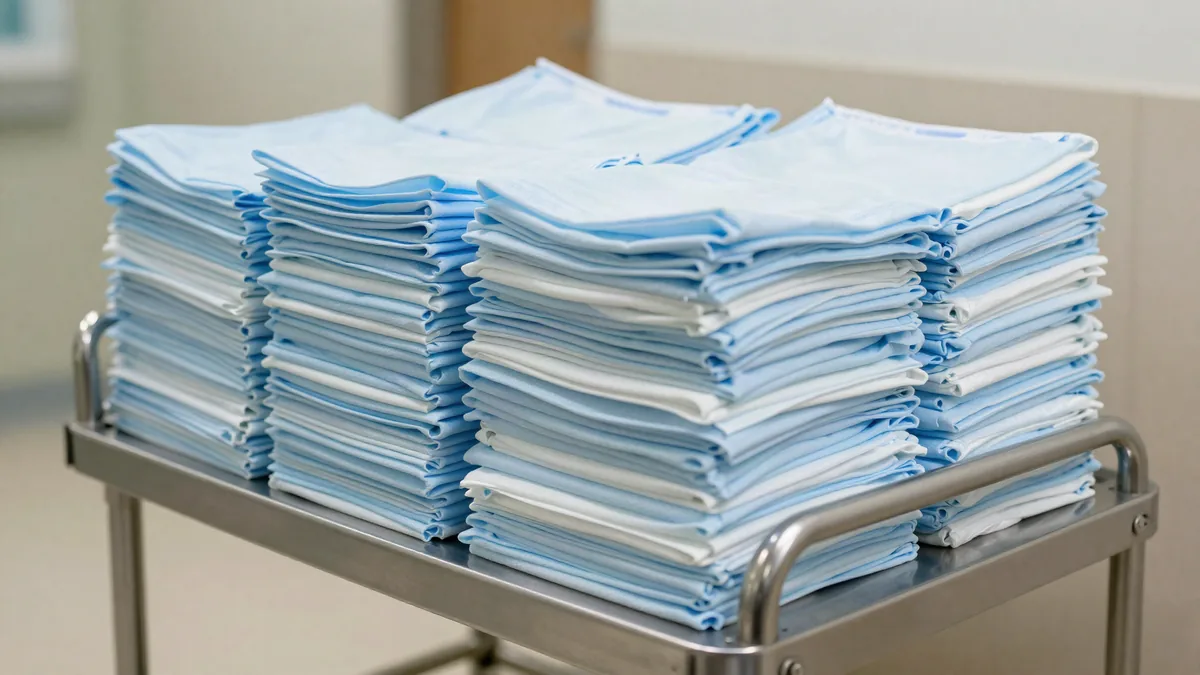
Healthcare linen splits by contamination risk and regulatory exposure rather than by department. Patient-facing bedding and bath goods, garments, surgical textiles and cubicle curtains each carry a different soil load and a different consequence if the wash process fails, which is why a healthcare linen contract reads nothing like a hotel or restaurant one.
Patient bedding and bath
Flat sheets, draw sheets, pillowcases, bath towels and washcloths make up the highest-volume category by weight and carry the routine soil load of any inpatient bedding program: body fluids, food, and general use. They are washed to a documented hygienically clean standard rather than sterilized, since sterility is neither achievable nor necessary for bedding that will be handled by gloved staff before patient contact. Draw sheets and underpads see the heaviest contamination and the shortest realistic service life of anything in the bedding category, and a facility that tracks loss and replacement by category rather than as one bedding total gets a much clearer picture of where its linen budget is actually going.
Scrubs, gowns and isolation garments
Scrubs are typically either facility-owned and laundered on a hygienically clean cycle, or personally owned and taken home -- a distinction with real infection-control consequences that has pushed more facilities toward managed scrub programs in recent years. Isolation gowns face a heavier bioburden and are frequently single-use disposable rather than reusable specifically because the wash validation burden for a reusable gown used in isolation precautions is higher than most laundries want to carry. Where reusable isolation garments are used, the wash formula and chain of custody need to be validated and documented, not assumed to be covered by the facility's general hygienically clean process.
Surgical textiles and reusable barrier products
Reusable surgical gowns, drapes and back-table covers are barrier products, not just linen, and a laundry processing them needs to validate fluid-resistance performance after repeated wash cycles, not just cleanliness. This is a materially different service than hygienically clean processing, and it is usually run through a dedicated healthcare textile services provider rather than a general commercial laundry, because the liability profile if a barrier product fails during a procedure is entirely different from a stained bedsheet. Facilities using reusable surgical textiles should ask a prospective laundry directly whether it tracks fluid-resistance performance data per batch, not just per contract.
Cubicle curtains and privacy screens
Cubicle curtains are touched constantly and washed far less often than almost anything else in a healthcare facility, which makes them one of the more commonly cited items in infection-control surveys. Most facilities are moving toward a scheduled replacement or laundering cadence -- often quarterly -- rather than a visual-soil trigger, because visible soil is a poor proxy for the bioburden curtains actually carry between changes. Disposable curtain options exist and remove the laundering question entirely, at a higher per-use cost that some high-turnover units find worth paying.
Accreditation: HLAC, TRSA Hygienically Clean Healthcare
Two accreditation marks come up in nearly every healthcare linen RFP. HLAC (Healthcare Laundry Accreditation Council) accredits the laundry facility itself against a published set of standards covering everything from soil-to-clean separation to transport; HLAC accreditation covers what the inspection actually checks and why more hospital procurement departments are requiring it as a contract condition rather than treating it as a nice-to-have. TRSA's Hygienically Clean Healthcare certification instead validates the outcome -- that finished linen meets a microbial cleanliness threshold -- through regular independent testing rather than a facility audit. The two are complementary rather than competing: HLAC says the process is sound, Hygienically Clean says the output tested clean. A facility asking for only one of the two is leaving a real verification gap, and a laundry holding neither should be expected to explain, specifically, what it does instead to demonstrate hygienically clean output.
Wash standards: temperature, chemistry and CDC guidance
CDC guidance for healthcare laundry sets out two broad paths to hygienically clean linen: thermal disinfection using hot water (generally 160F or higher for a sustained period) combined with an appropriate detergent, or lower-temperature washing paired with a chemical disinfectant such as a chlorine-based bleach or comparable oxidizing agent, validated to achieve an equivalent microbial reduction. Hospital laundry standards walks through both paths and the pH, dwell time and chemical concentration variables that actually determine whether either one works in practice, not just on paper. Neither path is inherently superior -- a laundry running validated low-temperature chemistry can meet the same standard as one running hot water -- but procurement should ask which path a bidder uses and ask to see the validation data behind it, because 'we follow CDC guidance' without documented parameters is not a verifiable claim.
Soiled linen handling and OSHA 1910.1030
OSHA's Bloodborne Pathogens Standard, 29 CFR 1910.1030, governs how contaminated laundry is bagged, transported and handled from the point of collection through to the washer, and it applies to the facility generating the soiled linen as much as to the laundry processing it. OSHA 1910.1030 and soiled linen covers the specific requirements: leak-resistant bags or containers for linen that is wet or could soak through, universal precautions treating all soiled healthcare linen as potentially infectious regardless of visible contamination, and labeling requirements when soiled linen leaves the facility or crosses to a different handling protocol. Facility staff handling soiled linen at the collection point need PPE and training under the same standard, which is a cost and a liability that sits with the healthcare facility, not the laundry vendor, even when the laundry provides the carts and bags.
Long-term care and senior living: resident personals and loss control
Long-term care buys many of the same categories as acute care -- bedding, bath, garments -- but the buyer's real headache is different: resident personal clothing, not facility linen, generates most of the complaints. A resident's own clothing moving through an institutional laundry alongside dozens of other residents' items is a labeling and sorting problem first and a wash-quality problem second, and facilities that skip a rigorous labeling system lose garments constantly, which shows up as family complaints and state survey findings about lost or damaged resident property. Senior living and nursing home linen covers labeling systems that actually hold up through commercial wash cycles -- sewn-in tags outlast iron-on ones by a wide margin -- along with how facilities structure loss accountability with a vendor when a resident's clothing goes missing. Dignity matters here in a way procurement documents rarely capture: a resident who wears the wrong person's cardigan because of a sorting error experiences that as a real loss, not an administrative error, and turnaround time on personal items should be built into the contract separately from bulk linen turnaround, which can run on a slower, more economical cycle.
Contracting models: rental, customer-owned goods, co-operative
Rental programs, where the laundry owns the linen and bills per use or per pound, dominate acute care because they remove inventory management and replacement capital from the hospital's side entirely -- the facility never owns stock that ages out or falls out of par. Customer-owned goods, where the facility buys its own linen and pays only for processing, cost less per cycle but push inventory planning, replacement purchasing and par tracking back onto facility staff, which many healthcare systems are not staffed to do well. Cooperative and shared-service laundries, jointly owned by a group of hospitals or a health system, are a middle path that some regional systems use to get rental-like economics without a single external vendor holding all the leverage at renewal. The right model depends more on whether the facility has staff capacity to manage inventory than on raw cost per pound.
Joint Commission survey readiness for linen
Joint Commission surveyors do not typically cite a specific linen standard by number, but linen handling shows up constantly under infection control and environment-of-care tracers -- a surveyor pulling a soiled linen cart, checking a cubicle curtain's last-cleaned date, or asking staff to explain the facility's hygienically clean verification process. Facilities that keep accreditation certificates, wash validation data and cleaning schedules organized and staff-accessible pass these tracers without friction; facilities that have the documentation but only in a binder in an office three floors from the unit being surveyed create their own finding. The practical fix is simple and rarely done: give unit-level staff a one-page summary of what the linen program's accreditation covers and where the full documentation lives, before survey week rather than during it.
Census spikes and surge capacity
A hospital running a bad flu season or absorbing overflow from a regional event can see linen volume climb well beyond its contracted baseline with almost no notice, and a contract that does not address surge capacity in advance leaves the facility negotiating from a position of urgency exactly when it has the least leverage. The questions worth asking a bidder before signing: what volume increase can the plant absorb without a rate renegotiation, how much advance notice does surge capacity require, and does the contract define a surge rate now or leave it to be negotiated later, under pressure. Facilities that have been through a real census spike tend to over-weight this clause in the next contract; facilities that have not tend to skip it entirely, until they need it.
What a healthcare linen RFP must specify
A healthcare linen RFP needs to name the specific accreditation or certification required -- HLAC, Hygienically Clean, or both -- rather than asking generally for 'clean, quality linen,' which every bidder will claim to provide regardless of process. It should specify wash validation documentation the vendor must produce on request, the OSHA-compliant soiled handling process from point of collection, turnaround time by category (bulk bedding versus surgical textiles versus resident personals, if applicable), and a defined surge capacity clause with a pre-negotiated rate. Loss and damage accountability should be spelled out item by item rather than as a general liability clause, because linen loss disputes in healthcare are common and expensive to resolve after the fact. Facilities that skip the accreditation and validation requirements in the RFP itself typically end up requiring them retroactively, mid-contract, which is a much weaker negotiating position.
Healthcare linen providers by state
Accreditation status, wash validation documentation and surge capacity all vary by provider more than by region, but minimum volume requirements and turnaround commitments do shift with local market density. Healthcare linen providers by state breaks the directory down for hospitals, clinics and long-term care facilities comparing vendors directly, once the accreditation and contracting questions above are settled.
Common questions from procurement
Does hospital linen need to be sterile?
No -- sterility is reserved for surgical textiles and specific barrier products used in procedures. General patient bedding, bath linen and garments only need to meet a hygienically clean standard, verified either through HLAC process accreditation or TRSA Hygienically Clean testing, which is a lower and more achievable bar than sterilization for high-volume daily-use items.
What is the difference between HLAC and Hygienically Clean certification?
HLAC accredits the laundry's process -- facility layout, soil-to-clean separation, transport and documented procedures -- through an on-site audit. TRSA's Hygienically Clean instead tests the finished linen itself for microbial cleanliness on a recurring basis. They measure different things, which is why many hospital contracts require both rather than treating them as interchangeable options.
Who is responsible for OSHA compliance on soiled linen -- the hospital or the laundry?
Both, for different parts of the chain. The hospital is responsible for bagging, labeling and staff PPE at the point of collection under 29 CFR 1910.1030; the laundry is responsible for safe handling, transport and processing once it takes custody. A contract should state clearly where custody transfers, because that is where liability for an exposure incident typically gets argued.
How is nursing home linen different from hospital linen?
The biggest practical difference is resident-owned personal clothing, which hospitals mostly do not have to manage but nursing homes process constantly alongside facility bedding. That shifts the operational challenge from wash chemistry, which is largely solved, to labeling and sorting accuracy, where most long-term care linen complaints and losses actually originate.
Related on this site