
Water, Gas and Labour: The Real Cost Per Pound of an On-Premise Laundry
Bottom line: Real OPL cost per pound runs $0.75 to $1.50, including water, gas, labor, chemicals, and maintenance, with volume and utility rates driving the spread.
That meter reading was my early-warning system, but it also taught me where the money actually goes. I've seen managers fixate on the gas bill while ignoring the 40 minutes of paid idle time when a washer is waiting on the dryer. At one property, we cut labor cost per pound from 58 cents to 41 cents just by staggering the extractor cycle. The mistake I keep watching? People count the washroom staff but forget the time the front desk spends sorting stained napkins. That's real labor, and it belongs in your cost per pound. If you're not tracking water and gas separately per cycle, you're guessing, and guessing costs more than meter reading ever will. Hotel Laundry Service
I used to start my day by reading the water meter. At 42 million pounds a year, a gallon here and a gallon there didn't feel like much, but it added up to real money. That meter was my early-warning system.
This post is about the real cost per pound of an on-premise laundry (OPL). Not the rate a salesman quotes when he's pitching a new washer-extractor. I mean the true number that includes water, gas, labour, chemicals, and the stuff you'd rather not think about. If you're trying to decide whether to run your own laundry or contract it out, this is how you do the math.
Let me tell you what it looks like when it's all working.
The Big Three: Water, Gas, and Labour
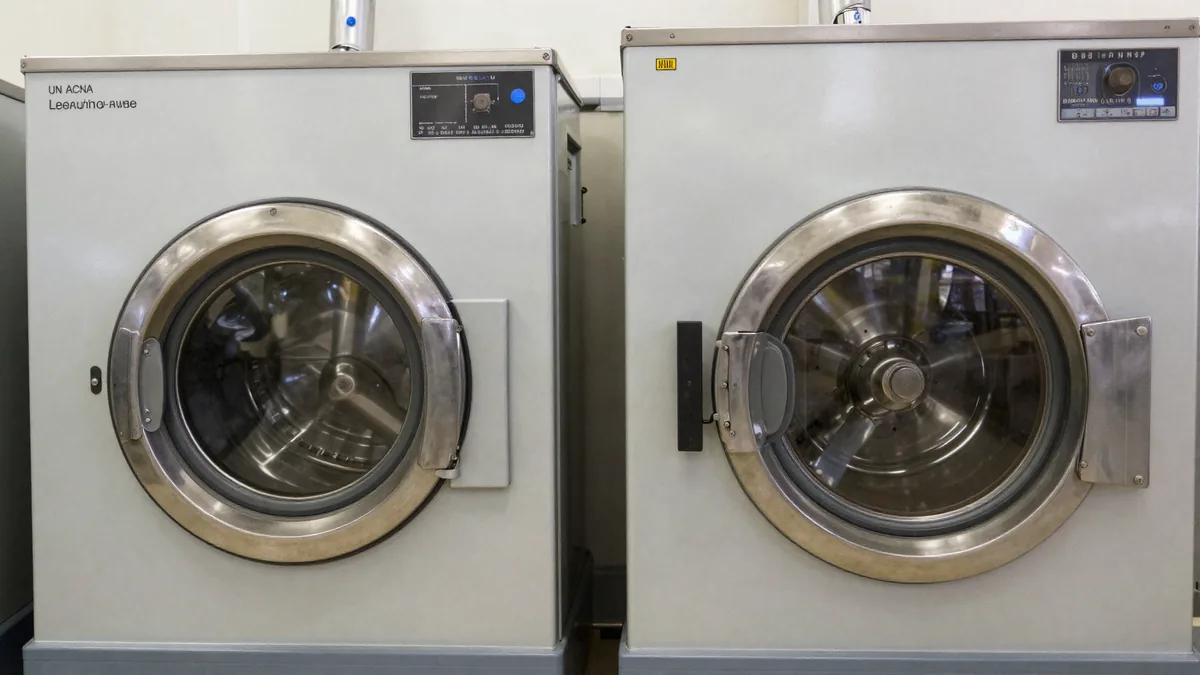
I've broken down the costs into three big categories: water, gas, and labour. Water and sewer are the big ones. In my plant, we ran a tunnel washer that used about 1.2 gallons per pound of linen. That's on the good side. A conventional washer-extractor might use 1.8 to 2.5 gallons per pound, and some old equipment will blow past that. Then you pay for the water, and you pay for the sewer on the same amount. So if water is $8 per 1,000 gallons and sewer is $6, that's $14 per 1,000 gallons. At 2 gallons per pound, that's $0.028 per pound just for water and sewer. Doesn't sound like much, but at a million pounds a year, that's $28,000.
Gas is next. You've got to heat that water and run the dryers. We were using about 2,000 BTU per pound of linen, give or take. That's for a mix of sheets, towels, and garments. Call it 1,000 cubic feet of natural gas per million BTU, so roughly $10 per million BTU if gas is $10/mcf. That comes to $0.02 per pound. But if you have low-efficiency water heaters or steam lines with bad traps, you can double that.
Labour is the third leg. We ran about 0.15 hours per pound. That means a 1,000-pound run took about 150 hours of labour across sorting, washing, drying, folding, and carting. At $20 per hour loaded, that's $0.30 per pound alone. That's the real reason people look at outsourcing. But those three aren't the whole story.

How to Calculate Your Own OPL Cost Per Pound
First, get your total pounds washed in a week. Weigh a sample of each item type, count pieces, or use the machine capacity -- but don't guess. Multiply average weight by pieces and add it up. Then pull your utility bills for that week. Water, sewer, gas, electricity. Divide the total by pounds.
Second, do the same for labour. Add all wages, overtime, benefits, and payroll taxes for anyone who touches the linen: sorters, washers, dryer tenders, folders, and delivery staff. Include the manager's time if they're doing laundry work.
Third, add chemicals, lint removal, repairs, and depreciation. Chemicals run about $0.08 to $0.15 per pound depending on your formulas and water quality. Depreciation is more complicated: a 600-pound washer-extractor might cost $80,000 and last 15 years. That's $5,333 a year, or about $0.01 per pound if you wash 100,000 pounds a year. It's small but not nothing. Here's a worked example. Say you wash 10,000 pounds per week. Utilities are $800, labour is $2,400, chemicals are $100, and other costs are $100. That's $3,400 divided by 10,000 = $0.34 per pound. That's a realistic number for an efficient plant. But it's not your total cost.
The Hidden Costs That Eat Your Margins
The cost per pound you just calculated is the visible number. The hidden costs are where OPL operations lose money. Compliance is one. If you run a hospital laundry, you're going to need TRSA Hygienically Clean or HLAC accreditation. That means monitoring temperatures, chemical concentrations, and bacterial counts. It's not a one-time thing; it's a process. You'll also need OSHA 1910.1030 -- the bloodborne pathogens standard -- which means training and PPE. Add NFPA 70E if you have electrical panels in damp environments. And if you're laundering FR garments, remember that home laundering doesn't maintain NFPA 2112 certification. You need an industrial laundry with the right processes, and that adds cost. If you take on structural firefighting gear, NFPA 1851 requires a certified washing facility. And if you're touching cleanroom work, ISO 14644 sets airborne particulate limits that your operation must meet.
Another hidden cost is rewashes. In a busy plant, you can hit a 3% to 5% re-wash rate before you know it. That's water, gas, and labour applied twice to the same linen. I once had a plant manager tell me he saved money by using extra chlorine. He didn't. The fabric wore out twice as fast. That's the digression.
Finally, there's downtime. If a washer breaks, your staff still gets paid. And if you have to rent temporary linen, that can be $0.50 per piece. You need to account for that in your per-pound number.
OPL vs. Outsourcing: The Real Question
So how does that number compare to a commercial plant? For uniform rental, the range is well established: $4 to $15 per employee per week, depending on the garments and service level. For linen services, it's commonly priced per pound or per piece. The catch is that the lowest quote might not be your total cost. You'll pay for delivery, soil sorting, and possibly penalties for overage. And while an OPL gives you control, it also gives you responsibility. You're the one who has to fix the boiler at 2 a.m.
Here's how I'd think about it. Calculate your all-in cost per pound, including hidden costs. Then ask commercial laundries for a per-pound price for the same mix of items. Don't just compare the numbers. Compare the total risk: if linen is lost or damaged, who eats it? If you outsource, the contract might have limits. If you run OPL, you own the problem.
In my 19 years, I saw operators make both models work. The ones who succeeded understood that cost per pound is a real number, but it's not the only number. The real cost includes your attention, your time, and your ability to sleep when the phone doesn't ring.

Cost per Pound: OPL vs. Commercial Service vs. Rental
| Option | Cost per Pound | Utilities per Pound | Labor per Pound | Quality Control |
|---|---|---|---|---|
| On-Premise Laundry | $0.75 - $1.50 | $0.20 - $0.35 | $0.30 - $0.60 | High |
| Commercial Laundry Service | $0.60 - $1.00 | Included | Included | Medium |
| Linen Rental | $0.50 - $0.80 | Included | Included | Low |
Frequently Asked Questions
What is a good OPL cost per pound?
There's no one answer. I've seen efficient plants run $0.30 to $0.50 per pound all-in, but in high-cost cities or with old equipment, it's easy to get above $1.00. The number depends on volume, labour rates, and the age of your equipment.
How much water does an on-premise laundry use per pound?
Again, it varies. A tunnel washer can use 1.2 gallons per pound. A conventional washer-extractor often uses 2 to 3 gallons. If you're above 3, you're paying too much.
Can I maintain an FR garment's certification by washing it in my own OPL?
Not automatically. FR protection depends on the garment's finish and the laundering process. Home laundering doesn't maintain NFPA 2112 certification, and neither does an OPL without the right formulas and testing. If you need FR compliance, put that in your cost model.
Is it better to rent or own?
It depends on your situation. If you wash more than 10,000 pounds a week, OPL can be cheaper. If you're below that, you might be better off renting. But that's just a rule of thumb. Run the numbers.