Cleanroom Garment Programs: ISO 14644 Classes and Gowning Cycles
Bottom line: Cleanroom garment service choice depends on your ISO class: ISO 5 requires sterile, validated reusable or single-use garments; ISO 8 can use standard industrial laundry. Costs range from $5 to $20 per use depending on class and program.
I once watched a hospital materials manager turn down a cleanroom garment service that met every spec because his CFO thought the rate was too high. Three months later they had an air sampler failure in the compounding suite. The temporary disposables cost them three times the contract he passed on. That's the trade-off you face: you can pay for validated laundering upfront or pay in failed audits. In my plant, we tracked particle counts per garment cycle, and we knew that reputable cleanroom garment service providers keep sterilization records down to the lot number. If your vendor can't show you that, find another. Industrial Laundry Service
Back in 2004, I stood in a semiconductor fab in Austin, watching a tech suit up in an ISO 5 gowning room. He had a protocol card taped to the wall, and he followed it like a pilot. I'd been running my plant for eight years by then, and that moment drove home how much a laundry service can make or break a cleanroom operation.
Cleanroom garments aren't your typical uniform rental. There's no one-size-fits-all program, and if you're in charge of sourcing them, you need to understand ISO 14644 classes and gowning cycles. Otherwise, you'll either overpay or fail an audit.
This is how I'd explain the whole system to a plant manager who's new to the cleanroom world. I've done this for 19 years, 42 million pounds a year at the peak, and I've seen a lot of cleanroom programs go sideways for the same few reasons.
What a cleanroom garment program actually is
Cleanroom garments are a barrier between the operator and the product. They don't just keep lint off a circuit board; they control static electricity and they keep your body's own particles—dead skin cells, dandruff, bits of hair—from getting into the air. A human being sheds millions of particles a minute just sitting still. In an ISO 5 cleanroom, you've got to cut that down to almost nothing.
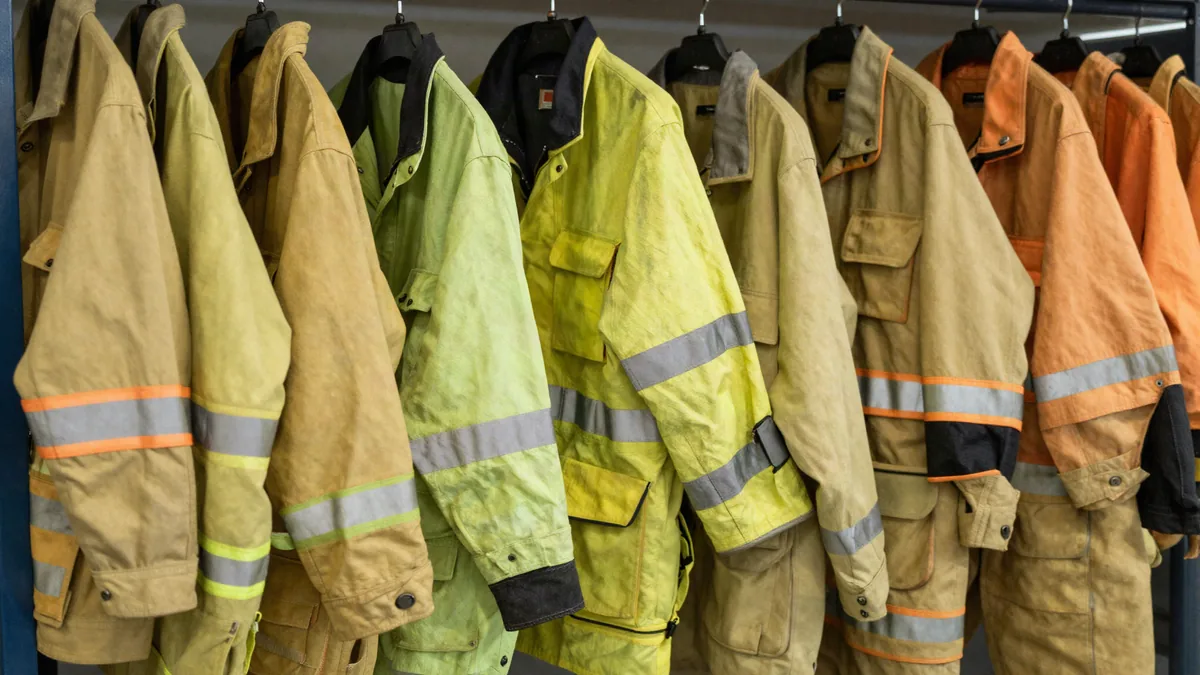
You've got two families of garments: reusable and disposable. Disposable DuPont Tyvek coveralls are cheap, and you throw them away after a day. But for a steady operation, reusables make sense. Woven polyester with a carbon filament grid controls static and lasts for many launderings. The catch is, every wash changes the fabric. That's where gowning cycles come in.
A cleanroom garment program is the whole system that manages that lifecycle. It includes the laundry, the packaging, the testing, and the tracking. If you're outsourcing it, you're buying clean, validated garments at a fixed price per garment—not per pound.
ISO 14644 classes and the gowning they demand
ISO 14644 is the international standard for cleanroom air cleanliness. The class number tells you how many particles are allowed in a cubic meter of air. ISO 5 is the old Class 100—3,520 particles at 0.5 µm or larger per cubic meter. ISO 7 is old Class 10,000. ISO 8 is old Class 100,000. For comparison, a typical office space has millions of particles per cubic meter.
What this means for your gowning: the lower the ISO number, the higher the level of protection you need. An ISO 8 or 7 area can get away with a frock and a hairnet. ISO 6 or 5 demands a full coverall, hood, boots, and sometimes a face mask. And the garment itself has to meet a particle-shedding class—the fabric shouldn't contribute anything beyond the air limit.
So when a garment comes back from laundry, you need to know that it still meets that class. That's validated by testing. The gowning cycle—the number of times a coverall can be laundered before it gets retired—is a number the laundry plant sets based on that fabric testing. There's no magic number that works for every fabric. Some woven polyesters hold up for 100 cycles. Others are shot at 60.

How industrial laundering keeps a cleanroom garment clean
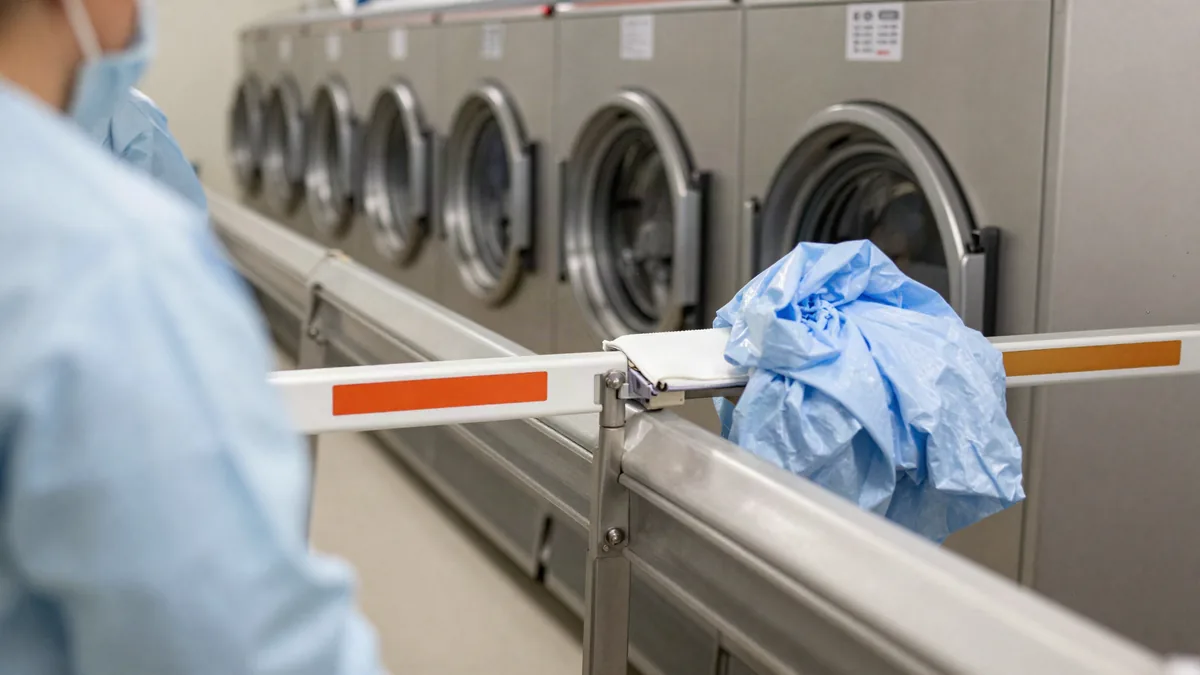
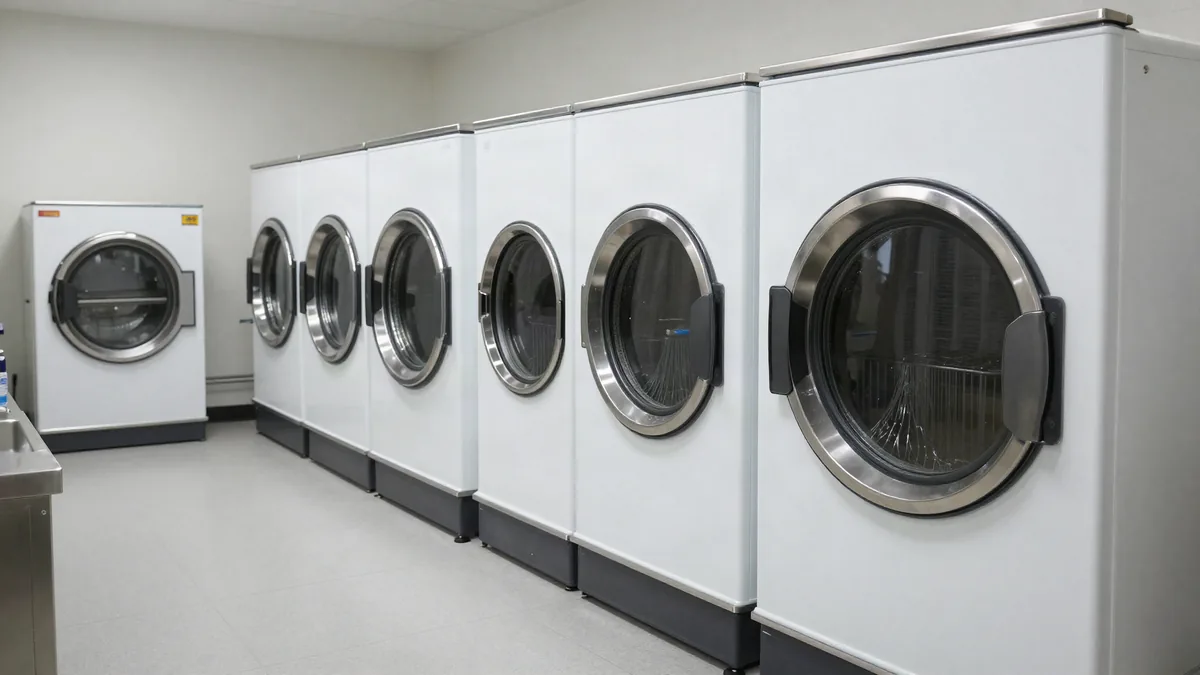
Industrial cleanroom laundering is nothing like home washing. We're talking about dedicated washers with deionized water, specific pH controls, and no softeners. The wash formula is tested to remove particulates without breaking down the fibers. After washing, garments go into HEPA-filtered dryers. Then they're packaged in cleanroom bags that stay sealed until used.
The whole process is validated under IEST RP-CC003, which is the American recommended practice for cleanroom garments. That's the same process used by plants that want to get TRSA Hygienically Clean certification, though that program is more about healthcare. If your cleanroom service can't show you a current validation report, you've got a problem.
Some cleanroom garments also get static decay testing. You don't want a coverall that holds a charge and zaps a microchip. That test is done on a fixture that measures how quickly a charge dissipates. I've seen plants skip it to save money. Don't let them.
Gowning cycles: when to call it
The gowning cycle is really the heart of this piece. It's the number of industrial launderings a garment can survive before it becomes a liability. For woven polyester, the typical range is 75 to 100 cycles. But that's set by the laundry plant's own testing, not by an industry rule. Some plants run a program where each garment has an RFID chip or a barcode. The system tracks how many times it's been processed. When it hits the limit, it's automatically pulled from circulation.
You should ask your provider two questions: What's the validated cycle limit, and how do you enforce it? If the answer is 'we just know' or 'it depends,' that's a red flag. The second question is more important than the first. A garment that's been washed 120 times might still look fine, but its particle shedding can go through the roof.
On the other hand, don't let a provider get cute with low limits to sell you more garments. You want a limit that's set by test data, not by marketing. A decent plant will be able to show you a chart of particle counts over time. That's real data. Get it in writing.
What to look for in a cleanroom garment service
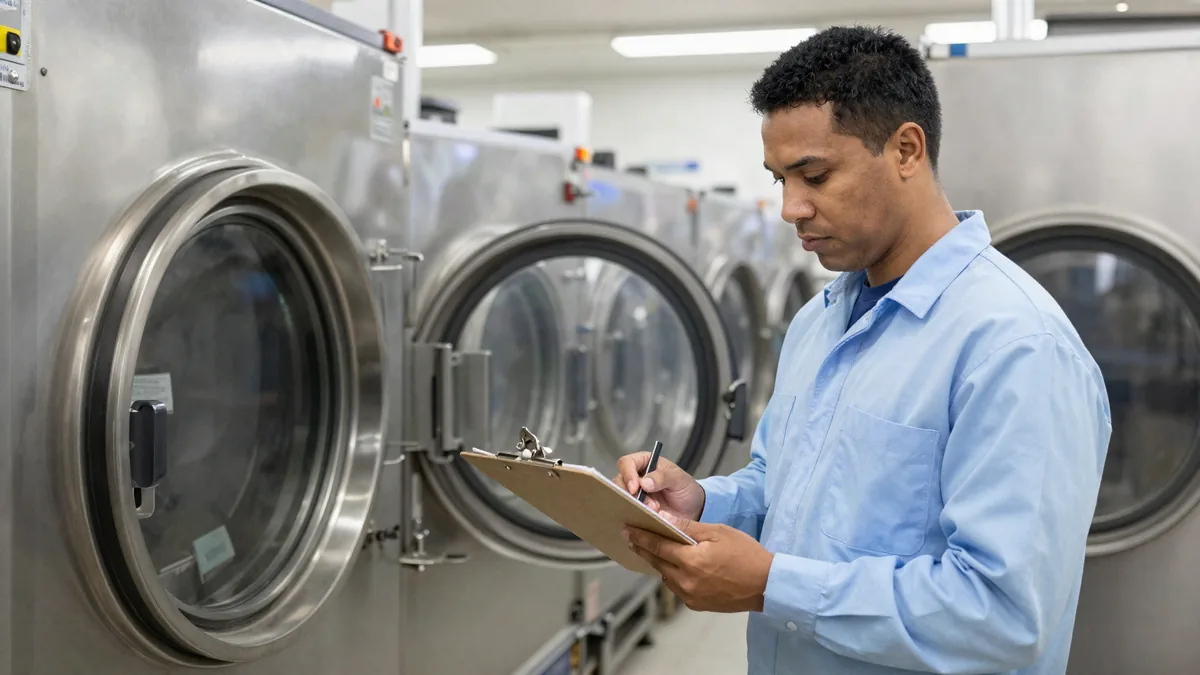
First, look for a plant that has a cleanroom classification for its own finishing and packaging areas. They should package your garments in an ISO 7 or better environment. Second, ask for their particle-count test results for the garments themselves. Third, look at the contract structure.
Pricing for cleanroom garment service is usually quoted per piece or per garment cycle, not per pound. That's because cleanroom garments need individual handling and transparent packaging. You'll pay a premium over standard uniform rental, which runs $4-15 per employee per week. Be prepared for quotes that are two to three times that, depending on the ISO class you need.
Contracts are where things get tricky. Look for exit clauses and price escalation terms. A three-year contract with a 5% annual increase isn't automatically bad, but you want the ability to audit the plant and test the garments yourself. If they refuse that, walk. The best providers will say, 'here's our test data, here's our cleanroom, inspect it anytime.' That's who you want.
Cleanroom Garment Program Models Compared
| Program Type | Upfront Cost | Cost per Cycle | Best for ISO Class | Main Failure Risk |
|---|---|---|---|---|
| On-Premise Laundry | $40k-$80k for equipment | $2-$5 | ISO 6-8 | Inadequate validation |
| Commercial Cleanroom Service | None | $8-$15 | ISO 4-5 | Logistics and delivery gaps |
| Disposable Garments | None | $12-$25 | ISO 3-5 | Supply chain disruptions |
Frequently Asked Questions
How often should cleanroom garments be replaced?
Depends on the fabric and the ISO class. For a woven polyester coverall in an ISO 5 area, expect 75-100 industrial laundry cycles, but the plant should validate every batch. Once particle shedding or static decay fails, the garment is done.
What is an ISO 5 cleanroom in old money?
ISO 5 is the modern name for Class 100. That means no more than 3,520 particles at 0.5 µm or larger per cubic meter of air. That's a tight environment, and it requires full gowning.
Can I launder cleanroom garments in-house?
You can, but you'd need a validated cleanroom laundry with deionized water and HEPA filtration. Most plants can't justify that capital spend. That's why cleanroom garment service exists.
How does pricing work for cleanroom garment service?
Usually per piece or per garment cycle, not per pound. A standard uniform rental runs $4-15 per employee per week, but cleanroom garments cost more because of handling, packaging, and testing. Expect to quote two to three times that, depending on the class.