Commercial Laundry Pickup and Delivery: How Routes Actually Work
"Pickup and delivery" sounds like a courtesy add-on, but on a commercial laundry contract it is closer to the operating backbone: which days a truck visits, how much buffer stock sits at your site between visits, and what happens at your dock in the minutes the driver is actually there decide more about service quality than the wash formula ever does. This page covers how route days get set, what turnaround windows actually mean, why par stock exists, what good soiled-handling looks like at your end, and the questions worth asking before you sign a route agreement that will run for the next several years. Most of the recurring service complaints that reach a provider's front desk trace back to one of these mechanics, not to wash quality itself.
What "pickup and delivery" means on a commercial contract
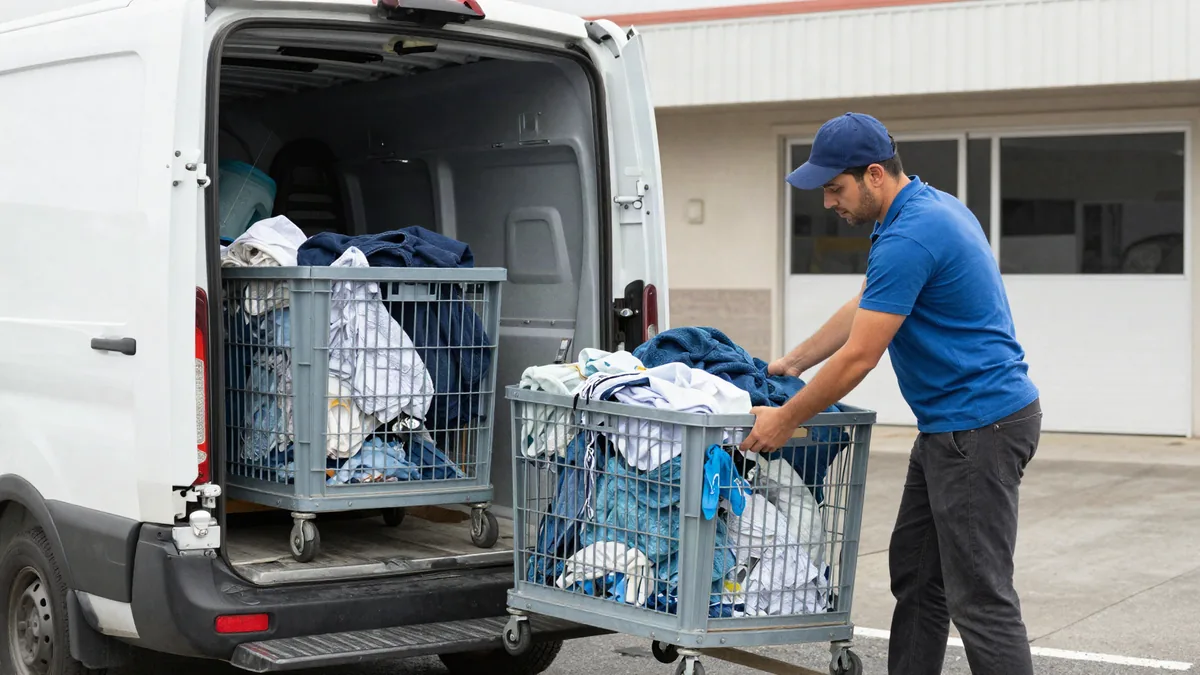
On a commercial laundry contract, pickup and delivery is not a courier add-on billed separately -- it is the route structure the entire service is built around. A provider commits to specific days, a specific turnaround window between collection and return, and a par stock level held at your site to cover the gap. Some providers list an explicit pickup-and-delivery capability against their listing, which is worth checking directly if you are comparing providers rather than assuming every laundry offers routed service as standard -- a number of smaller wash-and-fold operators still expect drop-off and collection in person. Confirming which model a provider actually runs before requesting a quote saves a round of calls with operators who were never going to fit your operation.
Route days: why you get Tuesday and Friday and not Monday
The days you are offered come from the provider's existing route map, not from a blank scheduling slate built around your preference. A truck already running a loop through your area on Tuesday and Friday can add your stop with minimal disruption; a request for Monday when no route currently passes through that day means either waiting for the route to grow into it or paying a premium for a dedicated run. The two variables below explain why a route day offer can look inflexible even from a provider that is genuinely trying to accommodate you.
Route density and how it sets your options
The more existing stops a provider has near you, the more flexible the days they can realistically offer, because your stop is an incremental addition to a loop that already exists rather than a new route built from scratch. Ask a candidate directly how many other accounts sit on your proposed route before assuming a five-day option is available just because it is listed on their website. A route listed as available on a marketing page and a route that is actually running at the density needed to support it are not always the same thing.
What happens when your volume grows mid-contract
Growing volume at a fixed twice-weekly route eventually outpaces the par stock buffer, forcing either a route-day renegotiation or a temporary rush collection at extra cost. Ask upfront what the process looks like for adding a route day mid-contract, and whether it requires a full contract amendment or a simple written request, before growth turns into an operational scramble. Providers with a denser local route generally absorb this kind of growth more gracefully than one running a thin route stretched across a wide territory.
Turnaround: 24 hour, 48 hour and same-day
Turnaround is the time between a provider collecting soiled textiles and returning the same category clean, and it drives your par stock requirement directly: a 48-hour turnaround needs roughly double the buffer stock of a 24-hour one to cover the same route frequency without running short. Same-day service exists mainly for smaller, specialty or emergency volumes and commands a real premium over standard route turnaround, since it typically requires breaking a normal production schedule to prioritize a single account's load ahead of everyone else's. Ask a provider to define turnaround by category rather than accept a single blended number -- flatwork and specialty items frequently move through the plant at different speeds even on the same route.
Par stock — the buffer that makes a two-day route work
Par stock is the quantity of clean linen or uniforms held at your site to cover the period between route visits -- if a route runs twice a week with a 48-hour turnaround, par stock has to cover roughly three to four days of usage to avoid running out before the next delivery. Set too low, a single missed or delayed pickup runs your site out of clean stock; set too high, you are carrying rental cost on inventory that sits idle on a shelf. Getting the par level right is a calculation worth doing explicitly with the provider rather than accepting whatever number a sales rep proposes by default. Revisit the par level whenever occupancy, headcount or seasonal demand shifts meaningfully -- a par calculated for a slow season will not hold up once volume climbs back to normal.

Soiled handling at your end
What happens to soiled textiles between use and pickup at your own site affects both turnaround quality and your invoice accuracy, and it is the part of the relationship entirely within your own control. Neither of the two practices below costs meaningful money to implement, and both pay for themselves the first time they prevent a billing dispute.
Carts, bags and chutes
Soiled linen should move from point of use to a dedicated holding area in a closed cart or bag rather than loose, both for basic hygiene and because loose textiles are far more likely to be damaged, lost, or miscounted before the route driver even arrives. Multi-story properties running a laundry chute need a receiving cart directly under it, not an open bin, to prevent exactly that kind of loss. The detailed handling standard for chutes and soiled rooms, including what an inspector actually checks for, is covered in soiled linen rooms, carts and chutes.
Counting and the receiving signature
A count taken at pickup and matched against a count at delivery, signed by both the driver and a member of your staff, is the single control that prevents most billing disputes before they start. Skipping the count because the driver is in a hurry, or because your own staff is short-handed that day, is how a "you shorted us" argument two months later becomes impossible to resolve either way. A detailed receiving procedure that assigns the count to a specific role rather than "whoever is on shift" is what actually makes the habit stick past the first few weeks of a new contract.
Rush, emergency and holiday collections
Unplanned volume spikes -- a large event, a plumbing failure that soaks a stockroom, a holiday period that compresses two route days into one -- fall outside the standard route and typically carry a rush or emergency surcharge on top of the base rate. Holiday-week schedules in particular shift for nearly every provider, and a route that normally runs Tuesday and Friday may collapse to one visit that week; asking for the holiday calendar in advance avoids finding out about the gap the hard way, mid-week, with no clean stock left. Properties with predictable peak periods -- a hotel's high season, a restaurant's holiday banquet calendar -- should raise par stock ahead of the peak rather than relying on a rush collection to cover a gap that was foreseeable months in advance.
Questions to ask before you sign a route agreement
A short list, asked directly and answered in writing rather than verbally on a sales call, resolves most of the route surprises that show up later in a contract's life. How many other stops currently sit on the proposed route, and how does that number change what days are realistically available. What is the actual turnaround time by item category, not just the fastest one quoted. What is the process, in writing, for adding a route day or increasing frequency as volume grows. What happens on federal holidays and how far in advance is the adjusted schedule communicated. And what is the rush or emergency collection rate, quoted as a number rather than "we'll work something out" -- a provider that cannot answer that question cleanly before signing is unlikely to answer it any better after.
Finding providers that collect in your area
Route coverage varies block by block in dense metro areas and can vary town by town everywhere else, so the practical starting point is commercial laundry service near you rather than a generic national search. For the operational detail behind the stages covered above, a receiving SOP that stops billing errors and optimising delivery frequency both go deeper into the route mechanics, and the 3-par rule is the fastest way to sanity-check the buffer number you landed on above.
Common questions about pickup and delivery
How do I know what route days a commercial laundry provider can actually offer me?
Ask directly how many other accounts already sit on the route that would serve your address. A dense existing route can usually add a stop with little friction; a request for a day the route does not currently run means either a dedicated pickup at extra cost or waiting for the route to grow into that day naturally.
What is a normal turnaround time for commercial laundry pickup and delivery?
Standard route service typically runs on a 24 to 48 hour turnaround between collection and return, depending on item category and provider. Same-day service is available from some providers for smaller or urgent volumes but usually carries a premium over the standard route rate, since it means breaking the normal production schedule to prioritize one account's load.
How much par stock should I keep on hand between deliveries?
Enough to cover usage through the longest gap between route visits, plus a small buffer for a delayed pickup. A twice-weekly route with 48-hour turnaround typically needs three to four days of stock on hand; a five-day route needs considerably less per visit, since the gap between deliveries is shorter.
What happens to my laundry pickup schedule around holidays?
Most providers shift their route calendar around major holidays, sometimes collapsing two weekly visits into one. Ask for the provider's holiday schedule in advance each year rather than assuming your normal route days hold, and plan par stock accordingly for the affected week so you are not caught short.