Apartment and Condo Laundry Rooms: Choosing a Provider
Multifamily laundry rooms are a facilities decision that gets revisited far less often than it should -- most properties sign a route operator agreement once, at lease-up or renovation, and then do not look at the contract again for seven to ten years because that is how long the agreement runs. That single decision shapes resident satisfaction, a recurring revenue or expense line, and a compliance exposure (ADA, plumbing code, dryer exhaust) that many property managers inherit rather than choose. This guide covers who actually supplies apartment laundry rooms and how each model gets paid, how to size a room against unit count, the accessibility and code questions that come up during renovation or a fire marshal visit, and the service-response terms worth writing into the agreement before a resident's second week of a broken dryer becomes a review.
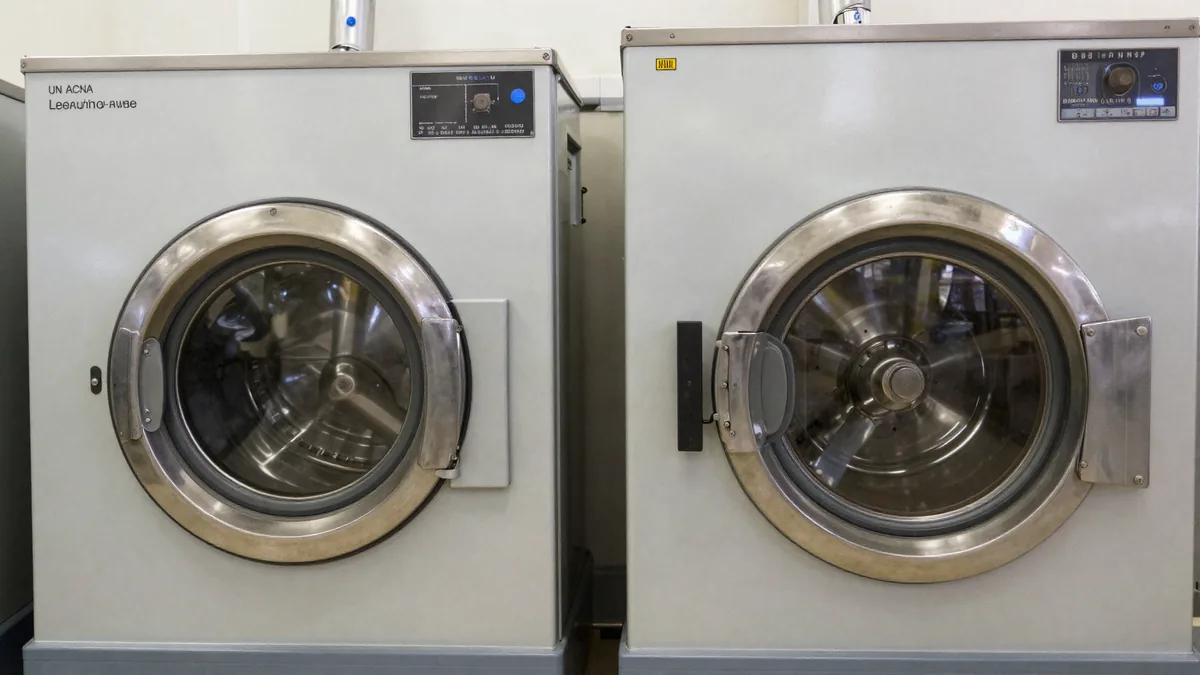
Who supplies apartment laundry rooms
Three distinct models supply multifamily laundry rooms, and they shift risk, revenue and maintenance responsibility differently enough that a property should choose deliberately rather than default to whatever the previous ownership group happened to have in place before the sale. Which one fits depends mostly on staffing and capital appetite, not building size.
Route operators (lease and revenue share)
A route operator owns the machines, handles all maintenance and collections, and pays the property either a flat lease fee or a percentage of revenue, which is the dominant model in US multifamily because it moves capital cost, service calls and cash handling entirely off the property's plate. The tradeoff is a long contract term and giving up some control over machine selection and pricing to the operator. This model suits properties without in-house maintenance staff who could realistically service commercial washers, which describes most mid-size multifamily operators without a dedicated engineering team.
Outright purchase and self-management
Buying machines outright and managing collections and service in-house keeps all revenue on the property's side and avoids a long-term contract, but it shifts maintenance risk and any coin or card processing infrastructure onto property staff. This usually only pencils out for larger properties with existing maintenance capacity, or ownership groups running enough buildings to justify a dedicated laundry technician across a portfolio. A single mid-size property buying machines outright without that staffing behind it typically ends up either neglecting maintenance or paying emergency service call rates that erase the savings from skipping a route operator's cut.
Full-service management contracts
Some operators offer a hybrid: the property still receives a defined payment, similar to a lease, but the contract bundles in resident-facing app support, more frequent preventive maintenance visits and faster guaranteed response times than a bare-bones revenue-share deal. These contracts cost the property a somewhat lower commission rate in exchange for a service level that reduces resident complaints, which matters more at properties competing on amenity quality than at pure workforce housing. The right question when comparing these against a standard lease is what the service-level difference is actually worth in resident retention.
Lease, revenue share or buy: how the money works
Every model above resolves to one of three payment structures, and the numbers only make sense once a property understands what specifically drives the commission rate and what a long contract term actually locks in beyond the headline percentage.
Commission rates and what drives them
Commission rates on a revenue-share lease are driven mainly by machine count, expected utilization and local utility costs, since the operator is pricing in its own water, gas and electric exposure before it ever gets to the property's cut. A high-utilization urban building with in-unit hookups unavailable to residents commands a better rate than a low-turnover suburban property with the same machine count, because the operator's revenue per machine is simply higher. Properties often assume the commission rate is the main negotiating lever, but service-level terms -- response time, machine age at installation, replacement schedule -- usually matter more to resident experience than an extra percentage point of commission.
Contract length and automatic renewal
Route operator agreements commonly run seven to ten years with automatic renewal clauses, which is far longer than almost any other vendor contract a property signs, and it is worth reading the renewal and removal terms before the commission rate gets any attention at all. Commercial laundry contracts is a useful reference for the clauses that matter most in a long-term lease: notice periods for non-renewal, what happens to installed machines if the contract ends, and whether the property can remove underperforming machines mid-term without breaching the agreement. A property that signs a ten-year deal without a clear early-termination path is locked in for a decade regardless of how service quality holds up.
Sizing the room: machines per unit
A common working ratio in US multifamily is one washer and one dryer per 12 to 20 units, tightened toward one per 10 units in buildings with larger households, no in-unit hookups, or a resident population that does laundry in bulk on weekends rather than spreading it through the week. Usage peaks hard on Saturday and Sunday afternoons in most buildings, so sizing for the peak rather than the weekly average matters more than the raw ratio suggests -- a room that looks adequately sized on a Tuesday can have a 40-minute wait on Sunday. Commercial laundry room design is a useful plumbing and layout reference for property teams planning a new or renovated room, covering drain capacity, gas or electric dryer venting runs and floor layout -- it is a design reference, not an equipment buying guide, and worth reviewing before finalizing a room's footprint.
Payment systems: coin, card and app
Coin-only laundry rooms are increasingly rare in new installations, mostly because collections require a physical cash run that both route operators and self-managed properties would rather not staff, and because residents increasingly do not carry the right coins at all. Card and app-based payment systems solve the cash-handling problem and typically increase machine utilization slightly, since residents are more likely to start a load on impulse without needing exact change on hand. App-based systems add the ability to notify a resident when a cycle finishes and to report a broken machine directly from the app, which reduces the maintenance-request friction that otherwise routes through a leasing office. The tradeoff is a per-transaction processing fee that ultimately gets built into either the resident's per-load price or the operator's margin.
Code and accessibility
Building code and ADA questions come up most often during a renovation, a fire marshal visit, or when a resident complaint prompts a property to actually check whether its laundry room complies with requirements it assumed were handled at construction.
ADA requirements in a common laundry room
Where a laundry room functions as a common amenity, it generally needs an accessible route from the building entrance, clear floor space in front of at least one washer and dryer, controls within a compliant reach range, and accessible door hardware into the room itself. Requirements vary meaningfully by jurisdiction and by the building's construction date -- a property built before the ADA's applicable design standards took effect may face different obligations than new construction -- so a specific compliance question should go to a local code official or an accessibility consultant rather than being assumed from a general national standard, which does not account for state and local overlays.
Ventilation, drainage and dryer exhaust
Dryer exhaust duct length and material are code-regulated for fire safety, not just efficiency, and route operators installing new machines should be confirming duct runs meet code rather than reusing an existing run built for a smaller or different generation of dryer. Floor drains sized for the room's total machine count, not just the original installation, prevent the standing water that shows up when a property adds machines to a room without revisiting drain capacity. Poor ventilation in an enclosed laundry room also creates a humidity and mold problem that shows up in complaints long before anyone connects it back to an undersized exhaust system installed years earlier.
Service response times and what to write into the agreement
A broken washer in a 20-unit building's only laundry room is a materially bigger problem than the same machine down in a 300-unit building with twelve machines, and a standard contract response-time clause rarely accounts for that difference. Properties should negotiate a specific response window -- 24 to 48 hours is a reasonable ask for a non-emergency repair -- and a defined penalty or credit if the operator misses it repeatedly, rather than accepting a vague 'prompt service' commitment that has no enforcement mechanism behind it. It is also worth specifying who residents contact directly when a machine breaks: a route operator's own service line reduces the leasing office's workload considerably compared with a model where every laundry complaint routes through property staff first.
Common laundry room complaints and how to design them out
The recurring complaints are predictable across almost every property: long waits at peak hours, machines that eat money without completing a cycle, a room that feels unsafe because of poor lighting or a blind corner, and a lack of seating or a place to fold. Peak-hour waits are a sizing problem, not a service problem, and no amount of faster repairs fixes a room that simply has too few machines for a Sunday afternoon. Machines eating money without finishing is almost always a card or app payment system issue rather than a coin mechanism failure at this point, and it is worth confirming whether the payment system the operator uses handles failed cycles with an automatic refund, since residents notice immediately when it does not. A folding counter and decent lighting cost little relative to the machines themselves and measurably reduce the safety and comfort complaints that otherwise land on the leasing office every month.
Finding apartment laundry providers in your city
Route operator availability, commission rates and machine brands all vary by metro, and a property in a dense urban market is negotiating from a different position than one in a smaller regional market with fewer operators competing for the contract. The directory covers apartment and condo laundry providers directly in major metros, including New York, Philadelphia and Chicago, for property managers who want to compare local operators rather than negotiate from a single incumbent's opening offer.
Frequently asked questions
How many washers and dryers does an apartment building need?
A common working ratio in US multifamily is one washer and one dryer per 12 to 20 units, tightened toward 1:10 in buildings with large households or no in-unit hookups. Usage peaks on weekend afternoons, so size for the peak, not the average.
Should a property lease laundry equipment or buy it?
A revenue-share lease with a route operator removes capital cost, service risk and collections work, at the price of a long contract and a share of income. Buying outright pays back over roughly five to eight years if you have in-house maintenance; without it, the lease usually wins.
What are the ADA requirements for a common laundry room?
Where a laundry room is a common amenity it generally needs an accessible route, clear floor space at a compliant machine, reach ranges met for controls, and accessible door hardware. Requirements vary by jurisdiction and building age — confirm against your local adopted code.
How long are apartment laundry contracts?
Route operator agreements commonly run seven to ten years with automatic renewal, which is far longer than most other vendor contracts a property signs. Read the renewal and removal clauses before the commission rate.