How Hotels Buy Commercial Laundry Services
Hotels are the largest recurring buyer of commercial laundry capacity in the country, and the purchase looks nothing like a one-off service call. A 150-room limited-service property and a 400-room resort buy the same broad categories -- sheets, terry, food and beverage linen, uniforms -- but at wash volumes, turnaround windows and quality tolerances that most non-hospitality laundries have never had to hold. This guide covers what a hotel actually sends out, the cost-per-occupied-room benchmark that lets properties compare bids on equal terms, par level math, and the question every general manager eventually asks: keep running the on-premise laundry, or hand the whole program to a contract plant. It closes with what belongs in an RFP and how seasonal occupancy changes the contract terms worth negotiating.
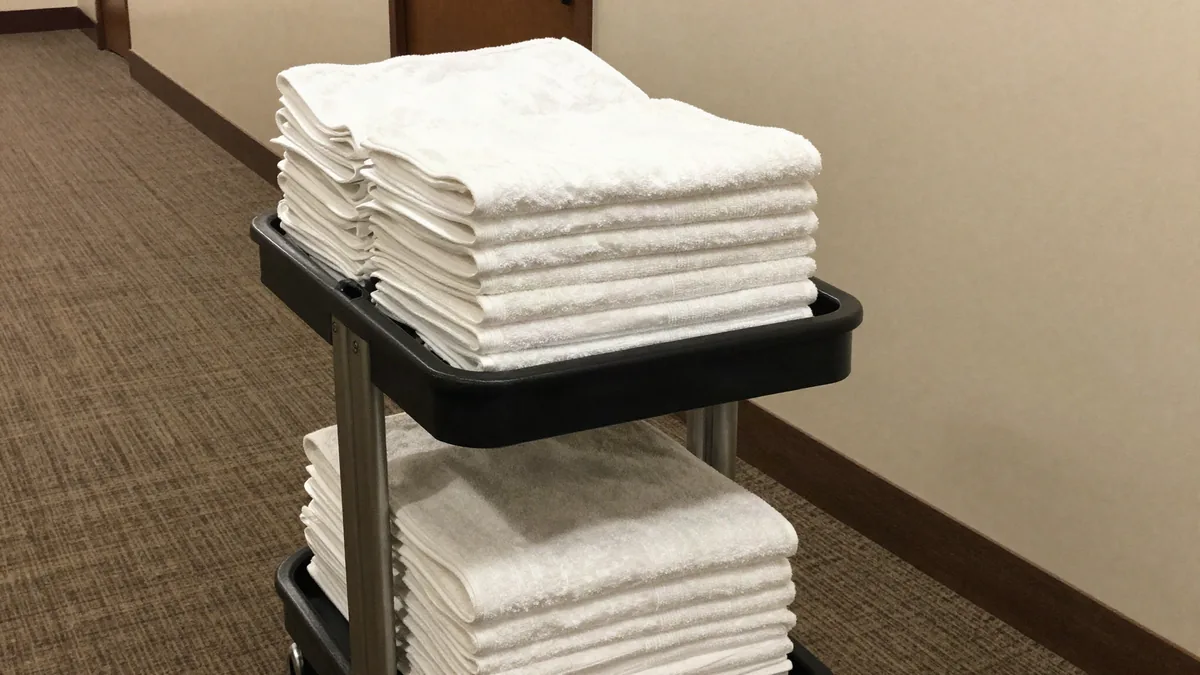
What a hotel actually sends out
A hotel linen program splits into four categories, and each carries a different wear pattern, contamination profile and replacement cycle. Housekeeping and food and beverage rarely share a vendor, because soil load and finish requirements differ enough that combining them into one contract usually costs more than running them separately.
Bed linen and duvet covers
Flat sheets, fitted sheets, pillowcases and duvet covers are the highest-volume, lowest-margin category and the one most exposed to price-per-pound bidding. Duvet covers wash heavier and dry slower than flat sheets because of the doubled fabric layer, a detail that changes cycle-time math on a volume bid more than most RFPs account for. Body oil, makeup and hair dye stains are routine and mostly launder out at standard hospitality wash formulas. The real failure mode is thread-count creep: housekeeping upgrades to a higher-count sheet the contracted wash chemistry was never specified to protect, and the property starts seeing early graying and tearing it blames on the laundry.
Bath terry and pool towels
Bath towels, hand towels, bath mats and pool towels take the heaviest mechanical action in the whole program, because terry loop needs aggressive extraction to dry in a reasonable cycle time, and that same extraction is what shortens fiber life. Where hotel towels really go covers the loss side of the terry budget, which usually outweighs wear: guest theft, housekeeping shortcuts that push damaged stock back into rotation, and towels quietly rerouted to rag-out instead of being counted and replaced on schedule. Pool terry deserves its own count separate from bath terry, since sunscreen oil and chlorine both attack the same fibers that heavy extraction is already stressing.
F&B linen: tablecloths, napkins, banquet skirting
Food and beverage linen runs on a different clock than housekeeping: banquet turns can require full room resets in under two hours, and a wedding block can double a property's napkin count for a single Saturday. Tablecloths and skirting are more likely to be customer-owned goods than housekeeping linen, because a hotel's banquet team usually wants ownership of pattern and color rather than whatever stock the laundry has on hand. Wine, candle wax and grease are the recurring stain categories, and grading them correctly at intake -- chargeable damage versus normal wear -- is where most F&B linen disputes start.
Staff uniforms
Front desk, housekeeping and food service uniforms are usually the smallest volume category by weight but the most visible to guests, which is why properties tend to specify a higher finish standard for them than for sheets. Housekeeping uniforms see the heaviest soiling and the shortest realistic service life; front-of-house uniforms see the least soiling but the strictest pressing and appearance standard. Most contracts price uniforms per-piece rather than per-pound, since weight tells you almost nothing about the labor a pressed uniform actually requires.
Cost per occupied room -- the only benchmark that travels
Cost per occupied room, not cost per pound, is the number that lets a 120-room select-service hotel compare its linen spend to a 500-room resort's. Pound pricing hides too many variables -- F&B linen mix, terry-to-sheet ratio, finish level -- to mean anything across property types. Most US properties benchmark between roughly $3.50 and $7.00 per occupied room for outsourced linen and terry in 2026, with full-service resorts running well above limited-service hotels because of pool terry volume and banquet linen. A property quoting outside that range should ask what is driving the gap: heavier F&B linen use, a higher finish spec, or a contract that has not been rebid in years and is simply stale. Occupancy, not room count, is what should be in the denominator when a GM tracks this monthly -- a property running 60% occupancy pays a very different real cost per room than the same property at 90%, even on an identical linen contract. Ask a bidder to quote both the per-pound rate and the resulting cost per occupied room at your actual trailing occupancy, not the plant's generic example, before comparing it to a competing bid.
Par levels for hotels: the 3-par rule and its exceptions
Three par is the standard working default in US hospitality: one set on the bed or in the bathroom, one clean set in house stock, and one set in the wash cycle at the laundry. It works because it assumes a same-day or next-day turnaround and a fairly predictable daily strip count. Properties on a two-day collection route, running high occupancy, or relying on a single weekly pickup generally need to move to four par, because the math no longer closes -- there is not enough clean stock in the building to cover the gap between strips and the linen's return. Seasonal peak properties sometimes run five par during their highest months rather than renegotiate a contract twice a year. Undersizing par is the single most common cause of a property calling housekeeping to say there are no clean sheets, and it is almost always a par math problem, not a laundry service failure.
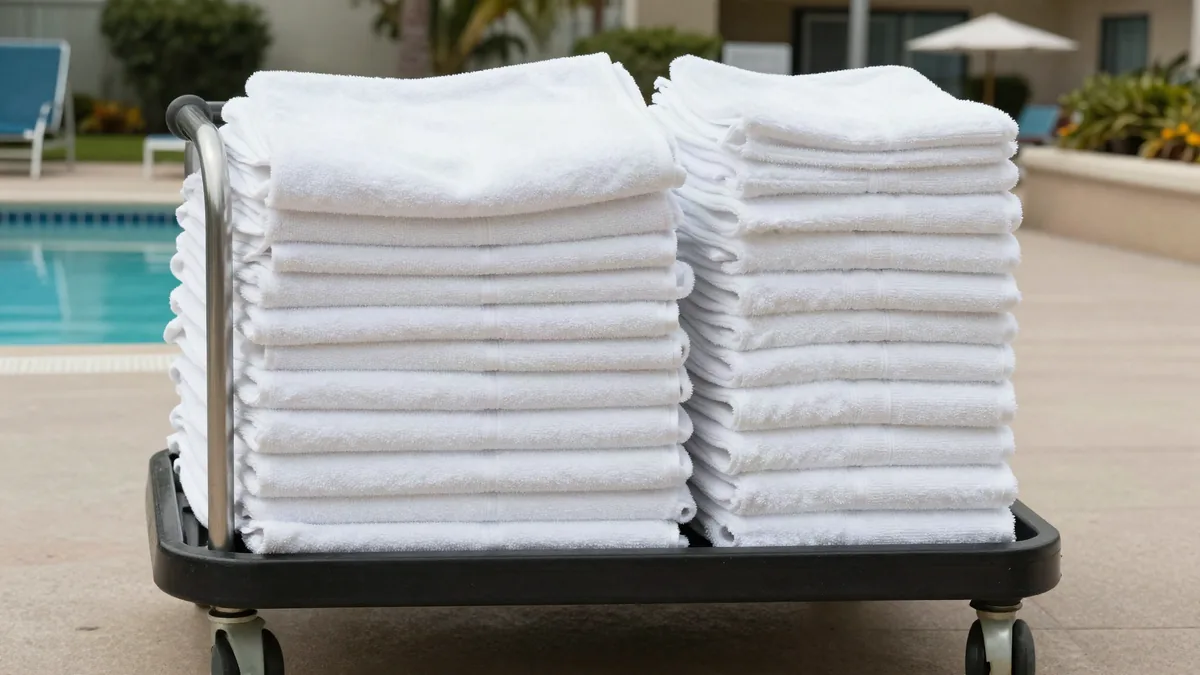
Outsourcing versus running an on-premise laundry
The build-or-buy question comes up at every hotel eventually, usually after a bad renewal quote. The honest answer depends less on room count than on occupancy pattern, existing back-of-house space, and whether the property already has staff who can run a laundry rather than housekeeping. Airbnb laundry service sits at the opposite end of this spectrum -- a model built entirely around outsourcing because short-term rental operators rarely have the volume or space to justify anything else.
The break-even room count
The break-even usually sits somewhere between 120 and 250 rooms, but that range moves a lot with occupancy pattern. A steady-occupancy property with cheap utilities, existing back-of-house square footage and a stable labor market is the classic on-premise laundry candidate. A property with sharp seasonal swings -- a ski resort or a beach property with a six-month season -- is generally better outsourcing, because an on-premise laundry sized for peak season sits half-idle the rest of the year, and one sized for the off-season cannot clear peak-week volume without paying heavy overtime.
What OPL costs once labour and utilities are counted
An on-premise laundry's sticker cost is the equipment; its real cost is labor, water, gas or steam, and the maintenance contract that keeps a washer-extractor and tunnel finisher running seven days a week. Properties that model OPL purely on equipment financing routinely underestimate the total by half, because a laundry needs dedicated staff whether it processes 2,000 or 6,000 pounds a day, and utility costs do not scale down proportionally at low volume. The properties that make OPL work well are usually the ones that already had spare back-of-house space and existing maintenance staff who could absorb the laundry equipment into their routine rather than hiring a dedicated laundry crew from zero.
Pool and spa terry: bleach, sunscreen and why terry fails first
Pool and spa terry takes damage from every direction at once: chlorine and bromine attack cotton fiber directly, sunscreen and body oil build up in the loop and go rancid if extraction and drying are not aggressive enough, and the heavy daily volume during season means more wash cycles per towel than any other category in the building. This is why pool terry should be tracked and budgeted separately from bath terry rather than folded into one combined towel count -- the replacement cycle is genuinely shorter, sometimes by half. Hotel laundry service in Florida is a useful reference point for how a year-round pool season changes the terry math compared with a property that only runs a pool deck for four months. Oxygen-based bleach alternatives reduce fiber damage compared with chlorine bleach in the wash formula itself, but they do not undo damage the pool water already did before the towel ever reached the laundry.

Seasonal surge and how to contract for it
Resort and seasonal-market hotels can see terry and linen volume more than double between shoulder season and peak, and a flat-rate annual contract priced at the average will either overcharge in the slow months or leave the laundry undersupplied at peak -- neither outcome holds for long. Summer resort and pool towel demand walks through sizing terry inventory specifically for the peak weeks rather than the annual average, which is the right unit to plan around. The contract terms worth negotiating up front are a volume band with a defined overage rate, a guaranteed turnaround time that holds during peak weeks and not just in the RFP response, and a stock reserve the laundry commits to holding so a sudden occupancy spike does not turn into a linen shortage on a Saturday night.
What to put in a hotel laundry RFP
An RFP that only asks for price per pound will get back bids that are impossible to compare, because pound pricing hides the finish spec, the F&B linen split and the turnaround guarantee. Specify wash formula and finish level by category, not just weight; require a stated turnaround window in hours, not 'next day'; ask for the vendor's loss and replacement policy in writing, including who eats the cost of guest theft; and require quality control checkpoints, not just a delivery schedule. Ask every bidder to quote against the same par level assumption, or the numbers will not be comparable no matter how carefully the rest of the RFP is written. Reference-checking with a property of similar size and seasonality matters more here than in most vendor categories, because hospitality laundry performance varies enormously by how well a plant already understands hotel linen specifically. Bidders who cannot name a comparable hospitality account, and cannot produce a reference contact for it, are usually newer to the category than their proposal suggests.
Hotel laundry providers by state
Pricing, minimum volume requirements and turnaround times all vary by market -- a plant serving a dense urban submarket runs different economics than one serving a spread-out resort corridor. Hotel laundry providers by state breaks the directory down by state and market for hotels that want to compare providers directly rather than work from national averages, which is the better place to start once the buying criteria above are settled.
Frequently asked questions
How much does hotel laundry cost per room?
Most US properties benchmark between roughly $3.50 and $7.00 per occupied room for outsourced linen and terry in 2026, depending on service level, whether F&B linen is included, and how much pool terry the property runs. Full-service resorts sit well above limited-service hotels.
Should a hotel outsource laundry or run its own?
The break-even usually sits somewhere between 120 and 250 rooms, but occupancy pattern matters more than room count. A property with sharp seasonal peaks is generally better outsourcing; a steady-occupancy property with cheap utilities and existing back-of-house space is the classic OPL candidate.
What par level should a hotel hold for linen?
Three par is the working default — one set on the bed, one clean in stock, one in the wash cycle. Properties on a two-day route, with high occupancy or with a single weekly collection generally need four.
Which hotel linens survive commercial laundry best?
Plain-weave cotton-polyester blends in the 200–300 thread count range last longest through industrial wash formulas. High thread count pure cotton, dark dyed terry and decorative trims all fail early under commercial chemistry and high extract speeds.
How quickly can a hotel switch laundry providers?
Four to eight weeks is realistic once notice periods, stock reconciliation and a parallel-run week are accounted for. The binding constraint is usually the outgoing contract's notice and auto-renewal clause, not the incoming provider's capacity.
Related on this site